 Formularium
Chapter 1 Algebra
1.1 Real numbers
1.1.1 Number line

1.1.2 Operator precedence
PEMDAS
Please Excuse My Dear Aunt Sally
-
• Parentheses
-
• Exponents
-
• Multiplication/Division
-
• Addition/Subtraction.
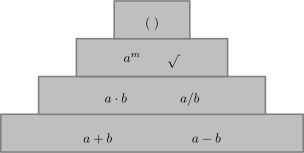
1.1.3 Parenthesis
\(\seteqnumber{0}{1.}{0}\)\begin{align*} a \cdot (b + c) &= a\cdot b + a\cdot c\\ (a + b) \cdot c &= a\cdot c + b\cdot c\\ (a\cdot b)\cdot c &= a \cdot b \cdot c \end{align*}
1.1.4 Sign
\(\seteqnumber{0}{1.}{0}\)\begin{align*} +\cdot + &= +\\ -\cdot - &= +\\ -\cdot + &= -\\ +\cdot - &= - \end{align*}
1.1.5 Parenthesis and sign
\(\seteqnumber{0}{1.}{0}\)\begin{align*} -(a\cdot b) &= - a\cdot b\\ &\overset {\text {\normalsize or}}{=} a \cdot (-b)\\ +(\pm a \pm b) &= \pm a+ \pm b\\ -(\pm a \pm b) &= \mp a \mp b \end{align*}
1.1.6 Fractions
\(\seteqnumber{0}{1.}{0}\)\begin{align*} \dfrac {a+b}{c} &= \dfrac {a}{c} + \dfrac {b}{c}\\ \dfrac {a}{b} + \dfrac {c}{d} &= \dfrac {ad + bc}{bd}\\ a \cdot \dfrac {1}{b} &= \dfrac {a}{b}\\ a \cdot \dfrac {b}{c} &= \dfrac {ab}{c}\\ \dfrac {a}{b} \cdot \dfrac {c}{d} &= \dfrac {ac}{bd}\\ \dfrac {ac}{bc} &= \dfrac {a}{b}\\ -\dfrac {a}{b} &= \dfrac {-a}{b} = \dfrac {a}{-b}\\ \left . \dfrac {a}{b} \middle / \dfrac {c}{d} \right . &= \dfrac {a}{b}\cdot \dfrac {d}{c} = \dfrac {ad}{bc} \end{align*}
1.2 Notable products
1.2.1 Notable products
\(\seteqnumber{0}{1.}{0}\)\begin{align*} (a+b)^2 &= a^2 + 2ab + b^2\\ (a-b)^2 &= a^2 - 2ab + b^2 \end{align*}
\(\seteqnumber{0}{1.}{0}\)\begin{align*} (a+b)(a-b) &= a^2 - b^2 \end{align*}
\(\seteqnumber{0}{1.}{0}\)\begin{align*} (a+b)^3 &= a^3 + 3a^2b + 3ab^2 + b^3\\ (a-b)^3 &= a^3 - 3a^2b + 3ab^2 - b^3 \end{align*}
\(\seteqnumber{0}{1.}{0}\)\begin{align*} (a-b)(a^2+ab+b^2) &= a^3-b^3\\ (a+b)(a^2-ab+b^2) &= a^3+b^3 \end{align*}
1.2.2 Newton’s binomial
\[(a+b)^n=\sum ^n_{k=0}{n \choose k}a^{n-k}b^k\]
\[\qquad \qquad \qquad \qquad \qquad \scriptsize \text {met }{n \choose k} = \frac {n!}{k!\cdot \left (n-k\right )!}\]
1.3 Polynomial
1.3.1 Zero polynomial
\[0\]
1.3.2 First degree polynomial
\[ax+b\]
\[x_0=\dfrac {-b}{a}\]
1.3.3 Second degree polynomial
\[ax^2+bx+c\]
Calculate \(D = b^2-4ac\)
-
• \(D>0 \Rightarrow \) two different roots \(\in \mathbb {R}\)
\(\seteqnumber{0}{1.}{0}\)\begin{align*} x_1 &= \dfrac {-b-\sqrt {D}}{2a}\\ x_2 &= \dfrac {-b+\sqrt {D}}{2a}\\ \end{align*}
-
• \(D=0 \Rightarrow \) two equal roots \(\in \mathbb {R}\)
\[x_1=\dfrac {-b}{2a}\]
-
• \(D<0 \Rightarrow \) no roots \(\in \mathbb {R}\)
-
• Factors: Are \(x_1\) and \(x_2\) roots
\[\Rightarrow ax^2+bx+c=a(x-x_1)(x-x_2)\]
1.3.4 Polynomials of higher degree
\[p(x)=a_nx^n + a_{n-1}x^{n-1} + \cdots + a_1x + a_0\]
-
• \(x\) : unknown
-
• \(a_ix^i\) : terms
-
• \(a_i\) : coefficients
-
• \(n\) : degree
-
• \(a_0\) : constant term
-
• The value of \(p\) in \(\alpha \in \mathbb {R}\) is
\[p(\alpha )=a_n\alpha ^n + a_{n-1}\alpha ^{n-1} + \cdots + a_1\alpha + a_0\]
-
• \(a\in \mathbb {R}\) is a root of \(p(x)\)
\[\Leftrightarrow p(a)=0\]
Synonyms: zero value of zero point
-
• \(d(x)\) is a factor of \(p(x)\)
\[\Leftrightarrow p(x)=d(x) \cdot q(x)\]
with \(q(x)\) a polynomial
-
• Link root and factors
\[p(a) = 0 \Leftrightarrow p(x) = (x-a) \cdot q(x)\]
with \(q(x)\) a polynomial
1.4 Exponents
1.4.1 Definition exponents
\(\seteqnumber{0}{1.}{0}\)\begin{align*} a^n &= \underbrace {a \cdot a \cdot \ldots \cdot a}_{n \text { factors}}\\ a^1 &= a \\ a^0 &= 1 \end{align*}
1.4.2 Negative exponent
\[a^{-n} = \dfrac {1}{a^n}\]
1.4.3 Sign of exponent
\(\seteqnumber{0}{1.}{0}\)\begin{align*} (\pm a)^{\overbrace {2k}^{\text {\normalsize even}}} &= + a^{2k} \\ (\pm a)^{\overbrace {2k+1}^{\text {\normalsize odd}}} &= \pm a^{2k+1} \end{align*}
1.4.4 Properties exponents
\(\seteqnumber{0}{1.}{0}\)\begin{align*} a^m\cdot a^n &= a^{m+n} \\\dfrac {a^m}{a^n} &= a^{m-n} \\\left (a^m\right )^{^n} &= a^{m\cdot n} \\\left (ab\right )^m &= a^mb^m \\\left (\dfrac {a}{b}\right )^m &= \dfrac {a^m}{b^m} \end{align*}
1.4.5 Rationale exponent
\[a^{n/m} = \sqrt [m]{a^n}\]
1.5 Square roots
1.5.1 Definition square root
\(x\) is a square root of \(a\)
\[\Leftrightarrow x^2=a\]
1.5.2 Properties square root
\(\seteqnumber{0}{1.}{0}\)\begin{align*} \sqrt {ab} &= \sqrt {a}\sqrt {b}\\ \sqrt {\dfrac {a}{b}} &= \dfrac {\sqrt {a}}{\sqrt {b}}\\ \sqrt {a^m} &= \sqrt {a}^{^m}\\ \sqrt {a^2} &= |a|\\ \sqrt {a} &= \sqrt [2]{a} \end{align*}
1.6 Roots
1.6.1 Definition roots
\(x\) is a \(n\)-th root of \(a\)
\[\Leftrightarrow x^n=a\]
1.6.2 Properties roots
\(\seteqnumber{0}{1.}{0}\)\begin{align*} \sqrt [n]{ab} &= \sqrt [n]{a}\sqrt [n]{b}\\ \sqrt [n]{\dfrac {a}{b}} &= \dfrac {\sqrt [n]{a}}{\sqrt [n]{b}}\\ \sqrt [n]{a^m} &= \sqrt [n]{a}^{^m}\\ \sqrt [n]{\sqrt [m]{a}} &= \sqrt [m\cdot n]{a}\\ \sqrt [n \cdot p]{a^{m\cdot p}} &= \sqrt [n]{a^m}\\ \sqrt [n]{a^n} &= \begin{cases} |a| & (n \text { is even})\\ a & (n \text { is odd})\end {cases} \end{align*}
1.7 Logarithms
1.7.1 Definition logarithm
\[\log _a x = y \Leftrightarrow a^y=x\]
1.7.2 Notable logarithms
\[ \begin {array}{l|c} \text {Name} & \text {Notation}\\ \hline \text {Briggse logarithm} & \log x = \log _{10} x\\ \text {Neperian logarithm} & \ln x = \log _e x\\ \text {Binary logarithm} & \lg x= \log _2 x\\ \end {array} \]
1.7.3 Properties logarithms
\(\seteqnumber{0}{1.}{0}\)\begin{align*} \log _a(x \cdot y) &= \log _a x + \log _a y\\ \log _a \dfrac {x}{y} &= \log _a x - \log _a y\\ \log _a \dfrac {1}{y} &= - \log _a y\\ \log _a(x^p) &= p \cdot \log _a x \end{align*}
\(\seteqnumber{0}{1.}{0}\)\begin{align*} \log _b x &= \dfrac {\log _a x}{\log _a b}\\ \log _b x &= \dfrac {1}{\log _x b} \end{align*}
1.8 Absolute value
1.8.1 Absolute value
\[|a| = \begin {cases} a & (a \geq 0)\\ -a & (a \leq 0) \end {cases}\]
\[|x| = \sqrt {x^2}\]
1.8.2 Properties absolute value
\(\seteqnumber{0}{1.}{0}\)\begin{align*} |a| &\geq 0\\ |a| &= 0 \Leftrightarrow a = 0\\ |a \cdot b| &= |a| \cdot |b|\\ |a + b| &\leq |a| + |b|\\ \Big | | a | \Big | &= |a|\\ |-a| &= |a|\\ |a-b| &= 0 \Leftrightarrow a = b\\ |a-b| &\leq |a-c| + |c-b|\\ \left |\dfrac {a}{b}\right | &= \dfrac {|a|}{|b|} \quad (b\neq 0)\\ |a-b| &\ge \Big | |a| - |b| \Big |\\ |a| &\leq b \Leftrightarrow -b \leq a \leq b\\ |a| &\geq b \Leftrightarrow a \leq -b \text { of } a \geq b \end{align*}
1.9 Divisibility
1.9.1 Divisibility
Definition: \(d\) divides \(a\)
\(\seteqnumber{0}{1.}{0}\)\begin{align*} &\Leftrightarrow d | a \\ &\Leftrightarrow d \in \mathbb {Z}_0 \land \exists q \in \mathbb {Z} : a = qd \end{align*}
-
• \(d \in \mathbb {Z}_0\) : divisor of \(a\)
-
• \(a \in \mathbb {Z}\) : multiple of \(d\)
-
• \(\text {del}(a)=\{d|a : d \in \mathbb {Z}_0\}\)
-
• \(d | a \Rightarrow -d | a\)
-
• \(d | a \Rightarrow d | -a\)
-
• \(\forall a \in \mathbb {Z} : \pm 1 | a\)
-
• \(\forall d \in \mathbb {Z}_0 : d | 0\)
-
• \(\forall a \in \mathbb {Z} : 0 \nmid a\)
-
• \(\forall d \in \mathbb {Z}_0 : d | d\)
\[ \left . \begin {aligned} d &| a\\ d &| b \end {aligned} \right \} \Rightarrow d | xa + yb,\; \forall x,y \in \mathbb {Z} \]
1.9.2 Common multiples/divisors
Least Common Multiple: \(m\) is the smallest natural number that is a multiple of \(a\) and \(b\)
\(\seteqnumber{0}{1.}{0}\)\begin{align*} &\Leftrightarrow m = \text {lcm(a,b)}\\ &\Leftrightarrow \begin{cases} m \in a\mathbb {Z} \cap b\mathbb {Z}\\ \forall c \in a\mathbb {Z} \cap b\mathbb {Z}: c \geq m \wedge c \neq 0 \end {cases} \end{align*}
Greatest Common Divisor: \(d\) is the greatest natural number that is a divisor of \(a\) and \(b\)
\(\seteqnumber{0}{1.}{0}\)\begin{align*} &\Leftrightarrow d = \text {gcd(a,b)}\\ &\Leftrightarrow \begin{cases} d \in \text {del}(a) \cap \text {del}(b)\\ \forall c \in \text {del}(a) \cap \text {del}(b): c \leq d \end {cases} \end{align*}
\[\text {lcm}(a,b) \cdot \text {gcd}(a,b) = a \cdot b\]
1.9.3 Euclidean Division
\[\forall a \in \mathbb {Z}, b \in \mathbb {Z}_0 : \exists ! q \in \mathbb {Z}, \exists ! r \in \mathbb {Z} :\]
\[a = bq + r \qquad (0 \leq r \lt |b|)\]
-
• \(q\) : quotient
-
• \(r\) : remainder
1.9.4 Prime Numbers
Definition: A prime number \(p \in \mathbb {N}\setminus \{0,1\}\) has only \(1\) and itself as positive divisors
\(\seteqnumber{0}{1.}{0}\)\begin{align*} &\Leftrightarrow p \text { is prime}\\ &\Leftrightarrow \text {div}(p) \cap \mathbb {N} = \{1,p\} \end{align*}
Fundamental Theorem of Arithmetic: Every \(n \in \mathbb {N}\setminus \{0,1\}\) can be factored into prime factors
\[n = p_1^{\alpha _1} \cdot p_2^{\alpha _2} \cdot ... \cdot p_k^{\alpha _k}\]
-
• \(p_1, ..., p_k\) : distinct prime factors
-
• \(\alpha _1, ..., \alpha _k \in \mathbb {N}_0\)
-
• \(\#\text {div}(n) = (\alpha _1 + 1)(\alpha _2 + 1) ... (\alpha _k + 1)\)
1.10 Summations
1.10.1 Definition
\[\sum ^n_{i=0} a_i = a_0 + a_1 + \cdots + a_n\]
-
• \(\Sigma \) : summation-symbol
-
• \(i\) : summation-index
-
• \(a_i\) : terms
1.10.2 Operations on summations
\[\sum _{i=0}^n a_i + \sum _{i=0}^n b_i = \sum _{i=0}^n(a_i+b_i)\]
\[\sum _{i=0}^n a_i - \sum _{i=0}^n b_i = \sum _{i=0}^n(a_i-b_i)\]
\[\sum _{i=0}^n a_i = \sum _{i=0}^m a_i + \sum _{i=m+1}^n a_i \qquad (m \lt n)\]
\[\sum _{i=0}^n (k \cdot a_i) = k \cdot \sum _{i=0}^n a_i\]
\[\sum _{i=0}^n k = (n+1)k\]
1.10.3 Summation identities
\[\sum _{i=1}^n i = \dfrac {n \cdot (n+1)}{2}\]
\[\sum _{i=1}^n i^2 = \dfrac {n \cdot (n+1) \cdot (2n+1)}{6}\]
\[\sum _{i=1}^n x^i = \dfrac {x - x^{n+1}}{1 - x} \qquad \text { met } x \neq 1\]
\[\sum _{i=1}^n (a_{i+1} - a_i) = a_{n+1} - a_1\]