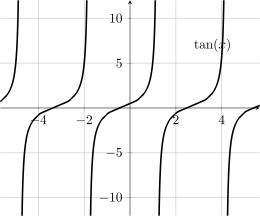
 Formularium
Chapter 5 Real functions
5.1 Real Functions
5.1.1 Definitions
Real function: a collection of pairs of real numbers \((x, y)\), such that each number \(x\) has at most one image \(y\).
Notation: \(f\), \(g\), \(h\), \(f_1\), \(f_2\), ...
Terminology: \((x,y) \in \mathbb {R}^2\)
-
• \(x\) argument, independent variable, abscissa, \(x\)-value
-
• \(y\) image, dependent variable, ordinate, \(y\)-value
-
• \(\in \) element of
-
• \(\mathbb {R}^2\) set of all pairs of real numbers
-
• function rule: \(f : \mathbb {R} \to \mathbb {R}:x \mapsto f(x)\)
-
• function value table
-
• graph
5.1.2 Characteristics of Real Functions
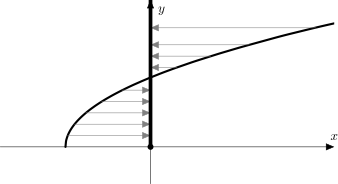
Domain
Definition: the set of all \(x\)-values for which the function has an image.
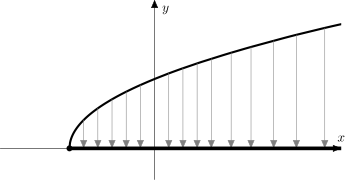
Range
Definition: the set of all images of a function.
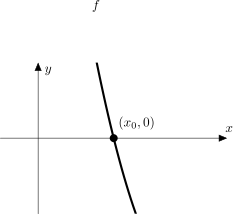
Zeroes
Definition: an \(x\)-value for which the image is equal to zero.
Algebraic: Set \(y=0\) in \(y=f(x)\). So search for all \(x\) for which
\[f(x)=0\]
Sign Behavior
Definition: determine the sign (positive, negative, or zero) of the image \(y\) as the argument \(x\) goes through the domain.
Method: Sign diagram with \(+\), \(-\), \(0\) and \(|\)
Increasing and Decreasing
-
• \(f\) is increasing in an interval \(I\) if for the \(x\)-values \(a,b \in I\) with \(a < b\) it holds that
\[f(a) \leq f(b)\]
-
• \(f\) is decreasing in an interval \(I\) if for the \(x\)-values \(a,b \in I\) with \(a < b\) it holds that
\[f(a) \geq f(b)\]
-
• \(f\) that is both increasing and decreasing in an interval \(I\) is called constant on that interval \(I\)
Method: Diagram with \(\nearrow \) and \(\searrow \)
Extrema
-
• real number \(m\) is the minimum of \(f\) on an interval \(I\) if for all \(x\in I:\)
\[f(x)\geq m\;.\]
-
• real number \(M\) is the maximum of \(f\) on an interval \(I\) if for all \(x\in I:\)
\[f(x)\leq M\;.\]
5.2 Polynomials
5.2.1 Polynomial
A polynomial is a sum of monomials:
\(\seteqnumber{0}{5.}{0}\)\begin{align*} P(x) &= a_n x^n + a_{n-1} x^{n-1} + \cdots + a_2 x^2 + a_1 x + a_0\\ &= \sum _{i=0}^{n} a_i x^i \end{align*}
-
• \(x\): variable
-
• \(a_i\in \mathbb {R}\): coefficients
-
• degree \(deg(P(x))\): the highest exponent of \(x\) in \(P\)
-
• value of \(P(x)\) for a given \(a\): replace \(x\) with \(a\)
-
• root: all \(a\) for which \(P(a)=0\)
5.2.2 Degree after operations
\(\seteqnumber{0}{5.}{0}\)\begin{align*} deg(A(x) + B(x)) &\leq \max (deg(A(x)),deg(B(x)))\\ deg(A(x) \cdot B(x)) &= deg(A(x)) + deg(B(x)) \end{align*}
5.2.3 Euclidean Division
\[A(x) = D(x) \cdot Q(x) + R(x)\]
\[ \qquad \qquad \text { with } deg(R(x)) \lt deg(D(x)) \vee R(x)=0\]
-
• \(A(x)\) : dividend
-
• \(D(x) \neq 0\) : divisor
-
• \(Q(x)\) : quotient
-
• \(R(x)\) : remainder
-
• exact division: \(R(x)=0\)
-
• non-exact division: \(R(x) \neq 0\)
-
• \(deg(A(x)) \lt deg(D(x)) \quad \Rightarrow \quad Q(x)=0 \wedge R(x)=A(x)\)
-
• \(Q(x)\) and \(R(x)\) exist and are unique
5.3 Polynomial Functions
5.3.1 General
Polynomial function: a real function with function formula
\[f(x)= a_nx^n + a_{n-1}x^{n-1} + \cdots + a_1x + a_0\]
5.3.2 Polynomial Functions of Degree 0
-
• Synonym: constant functions
-
• Form:
\[f(x) = a \qquad (a \in \mathbb {R})\]
-
• Graph: horizontal line parallel to the \(x\)-axis.
-
• Domain: \(\mathbb {R}\)
-
• Range: \(\{a\}\)
-
• Intersection with \(y\)-axis: \((0, a)\)
-
• Zeros:
\[ \begin {cases} \text {none} & (a \neq 0) \\ \text {every } x \in \mathbb {R} & (a = 0) \end {cases} \]
-
• Sign diagram:
\[ \begin {array}{c|lcr} x & -\infty & & +\infty \\ \hline f(x) & & \text {sign of }a & \end {array} \]
5.3.3 Polynomial Functions of Degree 1
-
• Synonyms: first-degree functions, linear functions
-
• Form:
\[f(x) = ax+b \qquad (a \in \mathbb {R}_0, b \in \mathbb {R})\]
-
• Graph: oblique line
\[ \begin {cases} \text {increasing oblique line} \nearrow & (a \gt 0) \\ \text {decreasing oblique line} \searrow & (a \lt 0) \end {cases} \]
-
• Gradient: \(a\) slope / rate of change
-
• Domain: \(\mathbb {R}\)
-
• Range: \(\mathbb {R}\)
-
• Zero: \(x_0=-\dfrac {b}{a}\)
-
• Intersection with \(x\)-axis: \((-\dfrac {b}{a}, 0)\).
-
• Intersection with \(y\)-axis: \((0, b)\)
-
• Sign diagram:
\[ \begin {array}{c|lcccr} x & -\infty & & -\dfrac {b}{a} & & +\infty \\[0.2cm] \hline f(x) & & \substack {\text {opposite }\\\text {sign } a } & 0 & \substack {\text {sign }\\a} & \end {array} \]
-
• Extrema: none
5.3.4 Polynomial Functions of Degree 2
-
• Synonyms: second-degree functions, quadratic functions
-
• Form:
\[f(x) = ax^2+bx+c \qquad (a \in \mathbb {R}_0, b,c \in \mathbb {R})\]
-
• Domain: \(\mathbb {R}\).
-
• Range:
\[ \begin {cases} \text {ran }f = [f(-\dfrac {b}{2a}), +\infty ) & (a \gt 0)\\ \text {ran }f = (-\infty , f(-\dfrac {b}{2a})] & (a \lt 0) \end {cases} \]
-
• Zeros: \(ax^2+bx+c=0\)
-
– \(D=b^2-4ac\)
-
– \(D>0 \Rightarrow \) two distinct zeros
\[x_1=\dfrac {-b-\sqrt {D}}{2a} \qquad x_2=\dfrac {-b+\sqrt {D}}{2a}\]
-
– \(D=0 \Rightarrow \) one zero
\[x_0=-\dfrac {b}{2a}\]
-
– \(D<0 \Rightarrow \) no zeros
-
-
• Sign diagram:
-
– \(D>0\)
\[ \begin {array}{c|ccccc} x & & x_1 & & x_2 &\\ \hline f(x) & \substack {\text {sign}\\a} & 0 & \substack {\text {opposite}\\\text {sign }a} & 0 & \substack {\text {sign}\\a} \end {array} \]
-
– \(D=0\)
\[ \begin {array}{c|lcccr} x & -\infty & & x_0 & & +\infty \\ \hline f(x) & & \substack {\text {sign}\\a} & 0 & \substack {\text {sign}\\a} & \end {array} \]
-
– \(D<0\)
\[ \begin {array}{c|lcr} x & -\infty & & +\infty \\ \hline f(x) & & \text {sign } a & \end {array} \]
-
-
• Graph: parabola with symmetry axis parallel to the \(y\)-axis
-
– \(a>0 \Rightarrow \) upward-opening parabola (concave up / happy)
-
– \(a<0 \Rightarrow \) downward-opening parabola (concave down / unhappy)
-
-
• Vertex:
\[(-\dfrac {b}{2a}, f(-\dfrac {b}{2a}))\]
\[ = (-\dfrac {b}{2a}, -\dfrac {D}{4a})\]
with \(D=b^2-4ac\)
-
• Increasing and decreasing:
-
– \(a \lt 0\)
\[ \begin {array}{c|lcr} x & & -\dfrac {b}{2a} & \\[0.2cm] \hline f(x) & \nearrow & \underset {=f(-\frac {b}{2a})}{\text {max}} & \searrow \end {array} \]
-
– \(a \gt 0\)
\[ \begin {array}{c|lcr} x & & -\dfrac {b}{2a} & \\[0.2cm] \hline f(x) & \searrow & \underset {=f(-\frac {b}{2a})}{\text {min}} & \nearrow \end {array} \]
-
5.4 Rational functions
5.4.1 Basic function
\[f(x)=\dfrac {1}{x}\]
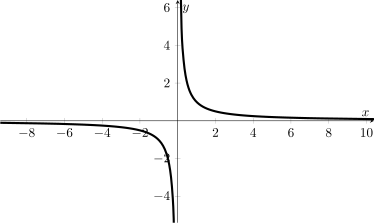
\[\text {dom }f = \mathbb {R}_0\]
\[\text {ran }f = \mathbb {R}_0\]
\[\text {zeros } f: \diagup \]
\[\text {H.A.}: y=0\]
\[\text {V.A.}: x=0\]
5.4.2 Homographic functions
\[f(x)=\dfrac {ax+b}{cx+d} \qquad (c\neq 0 \wedge a \cdot d \neq b \cdot c)\]
-
• Function rule: \(f(x)=\dfrac {ax+b}{cx+d} \;.\)
-
• poles \(f\): \(-\dfrac {d}{c}\)
-
• \(\text {dom }f = \mathbb {R} \setminus \{\text {poles}\}\)
-
• zeros \(f\): \(\begin {cases} x_0=-\dfrac {b}{a} & (a\neq 0)\\ \text {none} & (a=0) \end {cases}\)
-
• V.A.: \(x=\) poles
-
• H.A.: \(y=\dfrac {\text {coeff }x}{\text {coeff }x}\)
-
• \(\text {ran }f = \mathbb {R} \setminus \{\text {H.A.}\}\)
-
• Sign diagram: by splitting numerator and denominator
-
• Determine intersections
-
• Sketch graph
-
• Increasing and decreasing: based on the graph
5.4.3 Rational functions
\[y=\frac {t(x)}{n(x)}\]
-
• \(t(x)\): numerator, polynomial function
-
• \(n(x)\): denominator, polynomial function
5.5 Exponential Functions
5.5.1 Exponential Functions
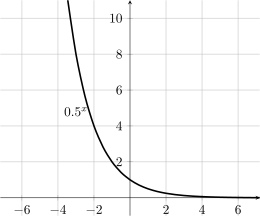
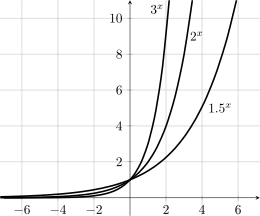
\[f(x) = a^x \qquad (a \in \mathbb {R}^+_0\setminus \{1\})\]
-
• \(a\): base
-
• \(x\): exponent
-
• Domain: \(\mathbb {R}\)
-
• Range: \(\mathbb {R}^+_0\)
-
• Zeroes: none
-
• Special points: \((0,1),\; (1,a)\)
-
• \(0 \lt a \lt 1\)
-
• \(a \gt 1\)
5.6 Logarithmic Functions
5.6.1 Logarithmic Function
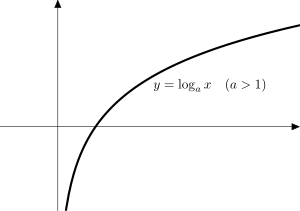
\[f(x) = \log _a x\]
-
• \(a\): base \(a\in \mathbb {R}^+_0\setminus \{1\}\)
-
• \(x\): argument
-
• \(\text {dom }\log _a x = \mathbb {R}^+_0\)
-
• \(\text {ran }\log _a x = \mathbb {R}\)
-
• Special points: \((1, 0),\;(a, 1)\)
-
• \(a \gt 1\)
-
– \(\log _a x\) is increasing in \(\mathbb {R}^+_0\)
-
– \(\lim _{+\infty } \log _a x = +\infty \)
-
– \(\lim _{x\underset {>}{\to }0} \log _a x = -\infty \)
-
-
• \(0 \lt a \lt 1\)
-
– \(\log _a x\) is decreasing in \(\mathbb {R}^+_0\)
-
– \(\lim _{+\infty } \log _a x = -\infty \)
-
– \(\lim _{x\underset {>}{\to }0} \log _a x = +\infty \)
-
-
• Asymptotes:
-
– V.A.: \(y\)-axis with equation \(x=0\)
-
5.6.2 Main Property of Logarithmic Functions
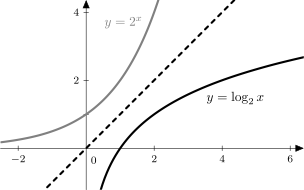
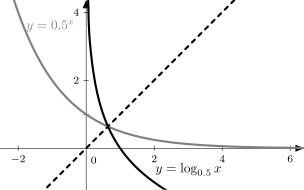
Property: The logarithmic function with base \(a\) and the exponential function with base \(a\) are inverse functions.
\[f(x)=a^x \Rightarrow f^{-1}(x)=\log _ax\]
Graphically: The graphs of the logarithmic and exponential functions are mirror images of each other with respect to the first bisector in an orthonormal coordinate system.
-
• \(a \gt 1\)
-
• \(0 \lt a \lt 1\)
5.7 Trigonometric Functions
5.7.1 Sine Function
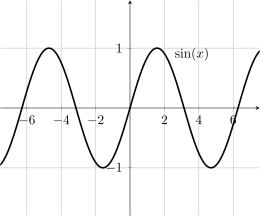
\[f(x) = a \sin (bx+c) + d\]
-
• Amplitude: \(|a|\)
-
• Period: \(T = \dfrac {2\pi }{|b|}\)
-
• Phase Shift: \(-\dfrac {c}{b}\)
-
• Vertical Shift: \(d\)
-
• Domain: \(\mathbb {R}\)
-
• Range: \([d - |a|, d + |a|]\)
5.7.2 Cosine Function
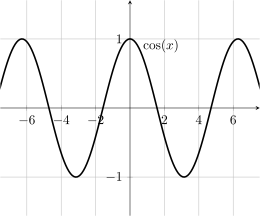
\[f(x) = a \cos (bx+c) + d\]
-
• Amplitude: \(|a|\)
-
• Period: \(T = \dfrac {2\pi }{|b|}\)
-
• Phase Shift: \(-\dfrac {c}{b}\)
-
• Vertical Shift: \(d\)
-
• Domain: \(\mathbb {R}\)
-
• Range: \([d - |a|, d + |a|]\)
5.7.3 Tangent Function
\[f(x) = a \tan (bx+c) + d\]
-
• Period: \(T = \dfrac {\pi }{|b|}\)
-
• Phase Shift: \(-\dfrac {c}{b}\)
-
• Vertical Shift: \(d\)
-
• Domain: \(\mathbb {R} \setminus \left \{ \dfrac {\pi }{2} + k\pi : k \in \mathbb {Z} \right \}\)
-
• Range: \((-\infty , +\infty )\)