 Formularium
Chapter 6 Analyse
6.1 Limits
6.1.1 Definition
\(b\) is the limit of \(f\) as \(x\) approaches \(a\)
\(\seteqnumber{0}{6.}{0}\)\begin{align*} &\Leftrightarrow \quad \lim _{x \to a} f(x) = b\\ &\Leftrightarrow \quad \forall \epsilon > 0, \exists \delta > 0, \forall x \in \text {dom} \,f :\\ & \qquad \qquad 0 < | x - a | < \delta \Rightarrow | f(x) - b | < \epsilon \end{align*}
6.1.2 Limit properties
\(\seteqnumber{0}{6.}{0}\)\begin{align*} \lim _{x \to a} \left ( f(x) \pm g(x) \right ) &= \lim _{x \to a} f(x) \pm \lim _{x \to a} g(x)\\ \lim _{x \to a} \left ( c \cdot f(x) \right ) &= c \cdot \lim _{x \to a}f(x) \qquad \text {met } c \in \mathbb {R}\\ \lim _{x \to a} \left ( f(x) \cdot g(x) \right ) &= \lim _{x \to a} f(x) \,\cdot \, \lim _{x \to a} g(x)\\ \lim _{x \to a} \dfrac { f(x) }{ g(x) } &= \dfrac {\lim _{x \to a} f(x)}{\lim _{x \to a} g(x)}\\ \lim _{x \to a} \left ( {f(x)}^{g(x)} \right ) &= {\left ( \lim _{x \to a} f(x) \right )}^{\lim _{x \to a} g(x)}\\ \lim _{x \to a} \left ( {f(x)}^n \right ) &= {\left ( \lim _{x \to a} f(x) \right )}^n\\ \lim _{x \to a} \sqrt [n]{f(x)} &= \sqrt [n]{\lim _{x \to a} f(x)} \end{align*}
6.1.3 Calculating infinity
\(\seteqnumber{0}{6.}{0}\)\begin{align*} (+\infty )+(+\infty ) &= +\infty \\ (-\infty )+(-\infty ) &= -\infty \\ k+(+\infty )&=+\infty \\ k+(-\infty )&=-\infty \\ (+\infty )\cdot (+\infty ) &= +\infty \\ (+\infty )\cdot (-\infty ) &= -\infty \\ (-\infty )\cdot (+\infty ) &= -\infty \\ (-\infty )\cdot (-\infty ) &= +\infty \\ \end{align*}
\(\seteqnumber{0}{6.}{0}\)\begin{align*} k\cdot (+\infty )&=\begin{cases}+\infty & (k \gt 0)\\-\infty & (k \lt 0)\end {cases}\\ k\cdot (-\infty )&=\begin{cases}-\infty & (k \gt 0)\\+\infty & (k \lt 0)\end {cases}\\ \dfrac {k}{+\infty }&=0\\ \dfrac {k}{-\infty }&=0\\ \dfrac {k}{0} &= +\infty \text { of } -\infty \end{align*}
6.1.4 Indeterminate forms
\[(\pm \infty )-(\pm \infty )\;,\quad (\pm \infty )+(\mp \infty )\]
\[\dfrac {\pm \infty }{\pm \infty }\;,\quad \dfrac {0}{0}\;,\quad \dfrac {k}{0} \]
\[0\cdot (\pm \infty )\;,\quad 1^{\pm \infty }\;, \quad 0^0\;, \quad (\pm \infty )^0\]
6.1.5 Properties of limits
\(\seteqnumber{0}{6.}{0}\)\begin{align*} \lim _{x\to a}c &= c \qquad (c \in \mathbb {R})\\ \lim _{x\to \pm \infty }c &= c\\ \lim _{x\to a}x &= a\\ \lim _{x\to \pm \infty }x &= \pm \infty \\ \lim _{x\to +\infty }x^k &= +\infty \qquad (k\in \mathbb {N}_0)\\ \lim _{x\to -\infty }x^k &= \begin{cases}+\infty &(k \text { is even})\\-\infty &(k \text { is odd})\end {cases}\\ \lim _{x\to \pm \infty }\dfrac {1}{x} &= 0\\ \lim _{x\underset {<}{\to }0}\dfrac {1}{x} &= -\infty \\ \lim _{x\underset {>}{\to }0}\dfrac {1}{x} &= +\infty \end{align*}
\[\lim _{x\to \pm \infty }\left (a_nx^n+a_{n-1}x^{n-1}+\cdots +a_0\right ) = \lim _{x\to \pm \infty }a_nx^n\]
6.1.6 Limits of polynomials
\[\lim _{x\to a}f(x)=f(a) \qquad \text { $f(x)$ is a polynomial and $a\in \mathbb {R}$}\]
\[\lim _{x\to \pm \infty }\left (a_nx^n+a_{n-1}x^{n-1}+\cdots +a_0\right ) = \lim _{x\to \pm \infty }a_nx^n\]
6.1.7 Limits of rational functions
\[\lim _{x\to a}\dfrac {f(x)}{g(x)}=\dfrac {f(a)}{g(a)} \qquad \text {if $g(a)\neq 0$}\]
\[\lim _{x\to a}\dfrac {f(x)}{g(x)}=\dfrac {k}{0}=\underbrace {+\infty \text { or } -\infty }_{\text {investigate sign}} \qquad \text {if $f(a)\neq 0$ and $g(a)=0$}\]
\[\lim _{x\to a}\dfrac {f(x)}{g(x)}=\dfrac {"0"}{0} =\lim _{x\to a}\dfrac {(x-a)\;\;f_r(x)}{(x-a)\underbrace {g_r(x)}_{\text {Horner}}}=\lim _{x\to a}\dfrac {f_r(x)}{g_r(x)}\]
\[\lim _{x\to \pm \infty }\dfrac {\left (a_nx^n+a_{n-1}x^{n-1}+\cdots +a_1x+a_0\right )}{\left (b_mx^m+b_{m-1}x^{m-1}+\cdots +b_1x+b_0\right )}=\lim _{x\to \pm \infty }\dfrac {a_nx^n}{b_mx^m}\]
6.1.8 Trig limits
\(\seteqnumber{0}{6.}{0}\)\begin{align*} \lim _{x \to 0}\dfrac {\sin x}{x} &= 1\\ \lim _{x \to +\infty }\dfrac {\sin x}{x} &= 0\\ \lim _{x \to 0}\dfrac {\cos x - 1}{x} &= 0 \end{align*}
6.1.9 Special limits
\(\seteqnumber{0}{6.}{0}\)\begin{align*} \lim _{x \to 0}\dfrac {e^x-1}{x} &= 1\\ \lim _{x \to 0}\dfrac {\ln (x+1)}{x} &= 1\\ \lim _{n \to +\infty }\left (1+\dfrac {1}{n}\right )^n &= e \qquad (n \in \mathbb {N})\\ \end{align*}
6.1.10 L’Hospital’s rule
\(\seteqnumber{0}{6.}{0}\)\begin{align*} \lim _{x \to a}\dfrac {f(x)}{g(x)} &= \dfrac {"0"}{0} \overset {\text {H}}{=} \lim _{x \to a}\dfrac {f'(x)}{g'(x)}\\ \lim _{x \to a}\dfrac {f(x)}{g(x)} &= \dfrac {"\pm \infty "}{\pm \infty } \overset {\text {H}}{=} \lim _{x \to a}\dfrac {f'(x)}{g'(x)}\\ \lim _{x \to \pm \infty }\dfrac {f(x)}{g(x)} &= \dfrac {"\pm \infty "}{\pm \infty } \overset {\text {H}}{=} \lim _{x \to \pm \infty }\dfrac {f'(x)}{g'(x)}\\ \end{align*}
6.2 Asymptotes
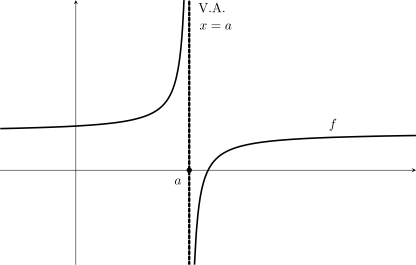
6.2.1 Vertical asymptotes (V.A.)
Graphical
A vertical asymptote of \(f\) is a vertical line that comes arbitrarily close to the curve of \(f\).
Algebraic
The line \(x=a\) is a vertical asymptote of \(f\) in \(a \in \mathbb {R}\)
\[\Leftrightarrow \lim _{x \underset {\gtrless }{\to } a} f(x) = \pm \infty \]
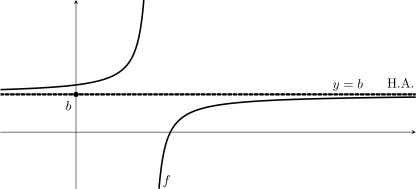
6.2.2 Horizontal asymptotes (H.A.)
Graphical
A horizontal asymptote of \(f\) is a horizontal line that comes arbitrarily close to the curve of \(f\).
Algebraic
The line \(y=b\) is a horizontal asymptote of \(f\)
\[\Leftrightarrow \lim _{x \to \pm \infty } f(x) = b \]
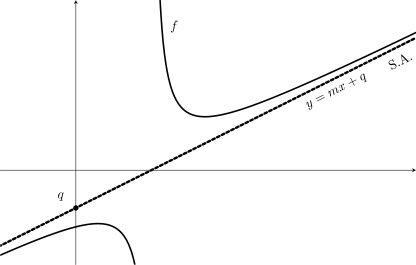
6.2.3 Oblique asymptotes (S.A.)
Graphical
A oblique asymptote of \(f\) is a oblique line that comes arbitrarily close to the curve of \(f\).
Algebraı̈sch
The line \(y=mx+q\) is a oblique asymptote of \(f\)
\(\seteqnumber{0}{6.}{0}\)\begin{align*} &\Leftrightarrow \lim _{x \to \pm \infty } \left (f(x) - mx -q \right ) = 0\\ &\Leftrightarrow \begin{cases} m = \lim _{x \to \pm \infty } \dfrac {f(x)}{x}\\ q = \lim _{x \to \pm \infty } \left ( f(x) - mx \right )\\ \end {cases} \end{align*}
6.3 Derivatives
6.3.1 Definition of the derivative
\(f'(a)\) is the derivative of \(f\) with respect to \(a\)
\(\seteqnumber{0}{6.}{0}\)\begin{align*} \Leftrightarrow f'(a)&=\lim _{h\to 0}\dfrac {f(a+h)-f(a)}{h}\\ \Leftrightarrow f'(a)&=\lim _{x\to a}\dfrac {f(x)-f(a)}{x-a} \end{align*}
6.3.2 Base derivatives
\(\seteqnumber{0}{6.}{0}\)\begin{align*} \left (c\right )'&=0\\ \left (x\right )'&=1\\ \left (x^2\right )'&=2x\\ \left (x^3\right )'&=3x^2\\ \left (x^n\right )'&=n\cdot x^{n-1}\\ \left (\sqrt {x}\right )'&=\dfrac {1}{2\sqrt {x}}\\ \end{align*}
6.3.3 Differentiation of exponential and logaritmic functions
\(\seteqnumber{0}{6.}{0}\)\begin{align*} \left (e^x\right )'&=e^x\\ \left (a^x\right )'&=a^x\cdot \ln a\\ \left (\ln x\right )'&=\dfrac {1}{x}\\ \left (\log _a{x}\right )'&=\dfrac {1}{x\cdot \ln a}\\ \end{align*}
6.3.4 Differentiation of trigonometric functions
\(\seteqnumber{0}{6.}{0}\)\begin{align*} \left (\sin x\right )'&=\cos x\\ \left (\cos x\right )'&=-\sin x\\ \left (\tan x\right )'&=\dfrac {1}{\cos ^2 x} = \sec ^2 x\\ \left (\cot x\right )'&=-\dfrac {1}{\sin ^2 x} = -\csc ^2 x\\ \left (\arcsin x\right )'&=\dfrac {1}{\sqrt {1-x^2}}\\ \left (\arccos x\right )'&=-\dfrac {1}{\sqrt {1-x^2}}\\ \left (\arctan x\right )'&=\dfrac {1}{1+x^2}\\ \left (\text {arccot } x\right )'&=-\dfrac {1}{1+x^2} \end{align*}
6.3.5 Differentiation formulas
\[(f+g)'(x) = f'(x)+g'(x)\]
\[(c \cdot f)'(x) = c\cdot f'(x)\]
\[(f \cdot g)'(x) = f'(x)\cdot g(x) + f(x)\cdot g'(x)\]
\[\left (\dfrac {f}{g}\right )'(x) = \dfrac {f'(x)\cdot g(x)-f(x)\cdot g'(x)}{g^2(x)}\]
\[\left (g\left (f\left (x\right )\right )\right )' = g'(f(x))\cdot f'(x)\]
6.3.6 Higher Derivatives
\[ \begin {array}{lccc} \text {Order} & f' & Df & \dfrac {\text {d}f}{\text {d}x} \\[1em] \hline \text {}\\ \text {first derivative} & f' & Df & \dfrac {\text {d}f}{\text {d}x}\\[1em] \text {second derivative} & f'' & D^2f & \dfrac {\text {d}^2f}{\text {d}x^2}\\ \qquad \quad \vdots \\ \text {$n$-th derivative} & f^{(n)} & D^nf & \dfrac {\text {d}^nf}{\text {d}x^n}\\ \end {array} \]
-
• \(f'\) : Lagrange’s notatie
-
• \(Df\) : Euler’s notatie
-
• \(\dfrac {\text {d}f}{\text {d}x}\) : Leibniz’s notatie
6.4 Function Analysis
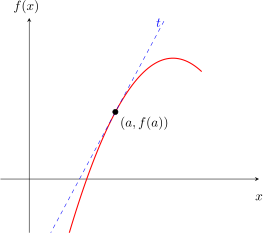
6.4.1 Tangent Line
Definition
The tangent line to the graph of \(f\) at \(x=a\):
-
• point: \((a,f(a))\)
-
• slope: \(f'(a)\)
-
• equation:
\[t \leftrightarrow y-f(a)=f'(a)(x-a)\]
6.4.2 Increasing and Decreasing of a Function
Increasing and Decreasing in an Interval
-
• \(f\) is increasing in \([a,b]\) if
\[\forall x_1,x_2 \in [a,b]: x_1 \lt x_2 \Rightarrow f(x_1) \leq f(x_2)\]
-
• \(f\) is decreasing in \([a,b]\) if
\[\forall x_1,x_2 \in [a,b]: x_1 \lt x_2 \Rightarrow f(x_1) \geq f(x_2)\]
-
• \(f\) is strictly increasing in \([a,b]\) if
\[\forall x_1,x_2 \in [a,b]: x_1 \lt x_2 \Rightarrow f(x_1) \lt f(x_2)\]
-
• \(f\) is strictly decreasing in \([a,b]\) if
\[\forall x_1,x_2 \in [a,b]: x_1 \lt x_2 \Rightarrow f(x_1) \gt f(x_2)\]
Increasing and Decreasing at a Point
-
• \(f\) is increasing at \(a \in \text {dom} f\) if
\[\exists B(a,\delta ) : f \text { is increasing in } (a-\delta , a+\delta ) \; \cap \; \text {dom} f\]
-
• \(f\) is decreasing at \(a \in \text {dom} f\) if
\[\exists B(a,\delta ) : f \text { is decreasing in } (a-\delta , a+\delta ) \; \cap \; \text {dom} f\]
Properties
\(f\) is differentiable over \([a,b]\) then \(\forall x \in ]a,b[:\)
-
• \(f'(x) \gt 0 \Rightarrow f \text { is strictly increasing in } [a,b]\)
-
• \(f'(x) \lt 0 \Rightarrow f \text { is strictly decreasing in } [a,b]\)
-
• \(f'(x) = 0 \Rightarrow f \text { is constant in } [a,b]\)
\(f\) is differentiable at \(a\):
-
• \(f\) is increasing at \(a\) \(\Leftrightarrow f'(a) \geq 0\)
-
• \(f\) is decreasing at \(a\) \(\Leftrightarrow f'(a) \leq 0\)
Rolle’s Theorem
\[ \begin {cases} f \text { is continuous in } [a,b]\\ f \text { is differentiable in } (a,b)\\ f(a) = f(b) \end {cases} \]
\[\Rightarrow \exists c \in (a,b) : f'(c) = 0\]
Lagrange’s Mean Value Theorem
\[ \begin {cases} f \text { is continuous in } [a,b]\\ f \text { is differentiable in } (a,b)\\ \end {cases} \]
\[\Rightarrow \exists c \in ]a,b[ : f'(c) = \dfrac {f(b) - f(a)}{b-a}\]
6.5 Integrals
6.5.1 Definitions
\(F\) is a primitive function of \(f\)
\[ \Leftrightarrow F' = f\]
\[[F(x)]_a^b = F(b) - F(a)\]
6.5.2 Properties of integrals
Integration and differentiation
Inverse operations!
\(\seteqnumber{0}{6.}{0}\)\begin{align*} \left (\int f(x) \;dx \right )' &= f(x)\\ \int F'(x) \;dx &= F(x) + C \end{align*}
\(\seteqnumber{0}{6.}{0}\)\begin{align*} \int f(x) + g(x) \;dx &= \int f(x)\; dx + \int g(x) \;dx\\ \int a f(x) \;dx &= a \int f(x) \;dx \end{align*}
6.5.3 Base integrals
\(\seteqnumber{0}{6.}{0}\)\begin{align*} \int \;dx &= x + C\\ \int x^n \;dx &= \dfrac {x^{n+1}}{n+1} + C \qquad (n \neq -1)\\ \int \dfrac {1}{x} \;dx &= \ln |x| + C\\ \int e^x \;dx &= e^x + C\\ \int a^x \;dx &= \dfrac {a^x}{\ln a} + C\\ \int \sin x \;dx &= -\cos x + C\\ \int \cos x \;dx &= \sin x + C\\ \int \dfrac {1}{\cos ^2 x} \;dx &= \tan x + C\\ \int \sec ^2 x \;dx &= \tan x + C\\ \int \dfrac {1}{\sin ^2 x} \;dx &= -\cot x + C\\ \int \csc ^2 x \;dx &= -\cot x + C\\ \int \dfrac {1}{1+x^2} \;dx &= \arctan x + C\\ \int \dfrac {1}{\sqrt {1-x^2}} \;dx &= \arcsin x + C\\ \int \dfrac {1}{\sqrt {x^2+k}} \;dx &= \ln |x + \sqrt {x^2+k}| + C\\ \int \sinh x \;dx &= \cosh x + C\\ \int \cosh x \;dx &= \sinh x + C\\ \end{align*}
6.5.4 Integration rules
\[\int f(t)\;dt = \int f(g(x))g'(x)\;dx\]
with \(t=g(x)\)
\[\int f'(x) \cdot g(x) \;dx = f(x) \cdot g(x) - \int f(x) \cdot g'(x) \;dx\]
6.5.5 Integration of Rational Functions
Method For integrating a rational function \(\dfrac {P(x)}{Q(x)}\):
-
1. If \(\text {deg}(P(x)) \ge \text {deg}(Q(x))\), perform polynomial long division:
\[\dfrac {P(x)}{Q(x)} = S(x) + \dfrac {R(x)}{Q(x)}\]
where \(\text {deg}(R(x)) < \text {deg}(Q(x))\).
-
2. Factor the denominator \(Q(x)\) into linear factors \((px+q)^m\) and/or irreducible quadratic factors \((ax^2+bx+c)^n\).
-
3. Decompose \(\dfrac {R(x)}{Q(x)}\) into a sum of partial fractions.
-
• For each factor \((px+q)^m\), the decomposition includes:
\[\dfrac {A_1}{px+q} + \dfrac {A_2}{(px+q)^2} + \dots + \dfrac {A_m}{(px+q)^m}\]
-
• For each factor \((ax^2+bx+c)^n\), the decomposition includes:
\[\dfrac {B_1x+C_1}{ax^2+bx+c} + \dfrac {B_2x+C_2}{(ax^2+bx+c)^2} + \dots + \dfrac {B_nx+C_n}{(ax^2+bx+c)^n}\]
-
-
4. Integrate the polynomial part \(S(x)\) and each partial fraction separately.
6.5.6 Applications of Definite Integrals
Area Between a Curve and the x-axis The area \(A\) between the graph of \(f(x)\) and the x-axis over the interval \([a,b]\):
\[ A = \int _a^b |f(x)| \,dx \]
Area Between Two Curves The area \(A\) enclosed by the graphs of \(f(x)\) and \(g(x)\) over the interval \([a,b]\):
\[ A = \int _a^b |f(x) - g(x)| \,dx \]
Volume of a Solid of Revolution The volume \(V\) of the solid obtained by rotating the graph of \(f(x)\) around the x-axis over \([a, b]\):
\[ V_x = \pi \int _a^b [f(x)]^2 \,dx \]
Arc Length of a Curve The length \(L\) of the arc of the graph of \(f(x)\) from \(x=a\) to \(x=b\):
\[ L = \int _a^b \sqrt {1 + [f'(x)]^2} \,dx \]