 Formularium
Chapter 3 Trigonometry
3.1 Angle
3.1.1 Degree
\(\seteqnumber{0}{3.}{0}\)\begin{align*} 1^\circ &= 60'\\ 1' &= 60''\\ \Rightarrow 1^\circ &= 3600'' \end{align*}
-
• \(^\circ \) : degree, complete circle \(= 360^\circ \)
-
• \('\) : minutes
-
• \(''\) : seconds
3.1.2 Radian
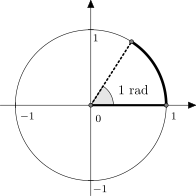
A radian (\(1\) rad): angle subtended from center of a circle where the arc = length of the radius.
-
• \(\theta \text { rad } = (\theta + k \cdot 2\pi ) \text { rad } (k \in \mathbb {Z})\)
-
• symbol rad can be omitted
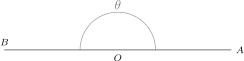
3.1.3 Angles
-
• angle are defined to a multiple of \(\adeg {360}\)
-
• positive angles: counter clock wise
-
• negative angles: clock wise
\(\theta \in [\adeg {0},\adeg {360}[\,:\)
-
• \(\theta \text { \bf zero angle } \Leftrightarrow \theta = \adeg {0}\)

-
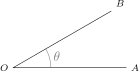
• \(\theta \text { \bf acute angle } \Leftrightarrow \adeg {0} \lt \theta \lt \adeg {90}\)
-
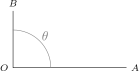
• \(\theta \text { \bf right angle } \Leftrightarrow \theta = \adeg {90}\)
-
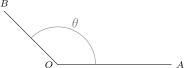
• \(\theta \text { \bf obtuse angle } \Leftrightarrow \adeg {90} \lt \theta \lt \adeg {180}\)
-
• \(\theta \text { \bf straight angle } \Leftrightarrow \theta = \adeg {180}\)
3.1.4 Connection between radians and degrees
\(\seteqnumber{0}{3.}{0}\)\begin{align*} 360^\circ = 2\pi \;\text {rad} \qquad \Rightarrow \quad x^\circ &= x\cdot \dfrac {\pi }{180}\;\text {rad}\\[1em] \quad x\;\text {rad} &= x \cdot \dfrac {180^\circ }{\pi } \end{align*}
3.2 Trigonometric numbers
3.2.1 Trigonometric numbers in a right triangle
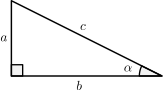
\begin{align*} \sin \alpha &= \dfrac {a}{c}\\ \cos \alpha &= \dfrac {b}{c}\\ \tan \alpha &= \dfrac {a}{b} \end{align*}
3.2.2 Trigonometric numbers in the unit circle
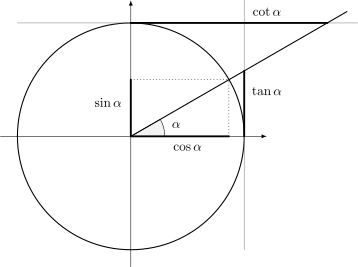
3.2.3 Definitions
\(\seteqnumber{0}{3.}{0}\)\begin{align*} \tan \alpha &= \dfrac {\sin \alpha }{\cos \alpha }\\[1em] \cot \alpha &= \dfrac {\cos \alpha }{\sin \alpha }\\[1em] \sec \alpha &= \dfrac {1}{\cos \alpha }\\[1em] \csc \alpha &= \dfrac {1}{\sin \alpha }\\[1em] \end{align*}
3.2.4 Pythagorean identities
\[\cos ^2 \alpha + \sin ^2 \alpha = 1\]
\(\seteqnumber{0}{3.}{0}\)\begin{align*} 1 + \cot ^2 \alpha & = \csc ^2 \alpha \\ \tan ^2 \alpha + 1 & = \sec ^2 \alpha \\ \sec ^2 \alpha + \csc ^2 \alpha & = \sec ^2 \alpha \csc ^2 \alpha \end{align*}
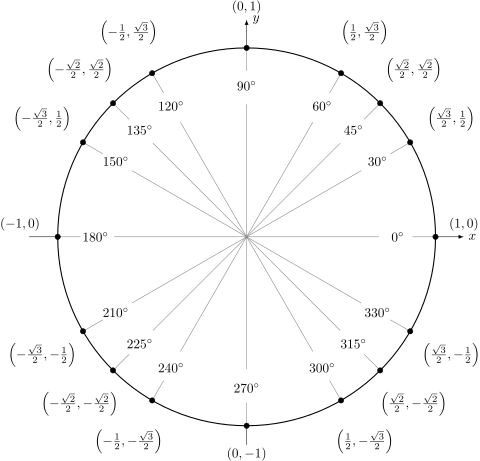
3.2.5 Common trigonometric values
\[ \begin {array}{r|cccccc} \alpha & \adeg {0} & \adeg {30} & \adeg {45} & \adeg {60} & \adeg {90} & \adeg {180} \\[1em] \hline \\ \sin \alpha & 0 & \dfrac {1}{2} & \dfrac {\sqrt {2}}{2} & \dfrac {\sqrt {3}}{2} & 1 & 0\\[1em] \cos \alpha & 1 & \dfrac {\sqrt {3}}{2} & \dfrac {\sqrt {2}}{2} & \dfrac {1}{2} & 0 & -1\\[1em] \tan \alpha & 0 & \dfrac {\sqrt {3}}{{3}} & 1 & \sqrt {3} & / & 0\\[1em] \end {array} \]
3.3 Triangle measurement
\[|\hat {A}|+|\hat {B}|+|\hat {C}|=\adeg {180}\]
3.3.1 Right triangles
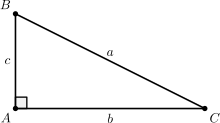
Pythagoras In \(\Delta ABC\) with \(|\hat {A}|=\adeg {90}\):
\[a^2=b^2+c^2\]
\(\seteqnumber{0}{3.}{0}\)\begin{align*} \sin |\hat C| &= \dfrac {c}{a} = \dfrac {\text {opposite}}{\text {hypotenuse}}\\ \cos |\hat C| &= \dfrac {b}{a} = \dfrac {\text {adjacent}}{\text {hypotenuse}}\\ \tan |\hat C| &= \dfrac {c}{b} = \dfrac {\text {opposite}}{\text {adjacent}}\\ \end{align*}
3.3.2 Random triangles
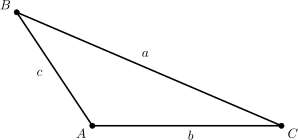
\begin{align*} a^2&=b^2+c^2-2 \cdot bc \cdot \cos |\hat A|\\ b^2&=a^2+c^2-2 \cdot ac \cdot \cos |\hat B|\\ c^2&=a^2+b^2-2 \cdot ab \cdot \cos |\hat C|\\ \end{align*}
\(\seteqnumber{0}{3.}{0}\)\begin{align*} \dfrac {a}{\sin |\hat A|}= \dfrac {b}{\sin |\hat B|}= \dfrac {c}{\sin |\hat C|} \end{align*}
3.4 Trigonometric identities
3.4.1 Pythagorean identities
\(\seteqnumber{0}{3.}{0}\)\begin{align*} \cos ^2\alpha + \sin ^2\alpha = 1\\ \Rightarrow 1 + \tan ^2\alpha &= \dfrac {1}{\cos ^2\alpha }\\ \cot ^2\alpha + 1 &= \dfrac {1}{\sin ^2\alpha } \end{align*}
3.4.2 Angle sum and difference identities
\(\seteqnumber{0}{3.}{0}\)\begin{align*} \sin (\alpha + \beta )&=\sin (\alpha )\cdot \cos (\beta )+\cos (\alpha )\cdot \sin (\beta )\\ \sin (\alpha - \beta )&=\sin (\alpha )\cdot \cos (\beta )-\cos (\alpha )\cdot \sin (\beta )\\ \cos (\alpha + \beta )&=\cos (\alpha )\cdot \cos (\beta )-\sin (\alpha )\cdot \sin (\beta )\\ \cos (\alpha - \beta )&=\cos (\alpha )\cdot \cos (\beta )+\sin (\alpha )\cdot \sin (\beta )\\ \tan (\alpha + \beta )&=\frac {\tan (\alpha )+\tan (\beta )}{1-\tan (\alpha )\cdot \tan (\beta )}\\ \tan (\alpha - \beta )&=\frac {\tan (\alpha )-\tan (\beta )}{1+\tan (\alpha )\cdot \tan (\beta )} \end{align*}
3.4.3 Double-angle formulae
\(\seteqnumber{0}{3.}{0}\)\begin{align*} \sin 2\alpha &= 2\cdot \sin \alpha \cdot \cos \alpha \\ \cos 2\alpha &= \cos ^2\alpha -\sin ^2\alpha \\ \cos 2\alpha &= 1 - 2\sin ^2\alpha \\ \cos 2\alpha &= 2\cos ^2\alpha - 1\\ \tan 2\alpha &= \dfrac {2\cdot \tan \alpha }{1-\tan ^2\alpha } \end{align*}
\(\seteqnumber{0}{3.}{0}\)\begin{align*} \sin 3\alpha &= 3 \cdot \sin \alpha - 4 \cdot \sin ^3 \alpha \\ \cos 3\alpha &= 4 \cdot \cos ^3 \alpha - 3 \cdot \cos \alpha \\ \end{align*}
3.4.4 Power-reduction formulae
\(\seteqnumber{0}{3.}{0}\)\begin{align*} \sin ^2\alpha &= \dfrac {1 - \cos 2\alpha }{2}\\ \cos ^2\alpha &= \dfrac {1 + \cos 2\alpha }{2} \end{align*}
3.4.5 Tangent half-angle substitution
\(\seteqnumber{0}{3.}{0}\)\begin{align*} \text {Set } t=\tan \dfrac {\alpha }{2} \\ \Rightarrow \sin \alpha &= \dfrac {2t}{1+t^2}\\ \cos \alpha &= \dfrac {1-t^2}{1+t^2}\\ \tan \alpha &= \dfrac {2t}{1-t^2} \end{align*}
3.4.6 Simpson’s formulas
\(\seteqnumber{0}{3.}{0}\)\begin{align*} 2 \cdot \sin \alpha \cdot \cos \beta &= \sin (\alpha +\beta ) + \sin (\alpha -\beta )\\ 2 \cdot \cos \alpha \cdot \sin \beta &= \sin (\alpha +\beta ) - \sin (\alpha -\beta )\\ 2 \cdot \cos \alpha \cdot \cos \beta &= \cos (\alpha +\beta ) + \cos (\alpha -\beta )\\ - 2 \cdot \sin \alpha \cdot \sin \beta &= \cos (\alpha +\beta ) - \cos (\alpha -\beta ) \end{align*}
\(\seteqnumber{0}{3.}{0}\)\begin{align*} \sin p + \sin q &= 2 \cdot \sin \frac {p+q}{2} \cdot \cos \frac {p-q}{2}\\ \sin p - \sin q &= 2 \cdot \cos \frac {p+q}{2} \cdot \sin \frac {p-q}{2}\\ \cos p + \cos q &= 2 \cdot \cos \frac {p+q}{2} \cdot \cos \frac {p-q}{2}\\ \cos p - \cos q &= -2 \cdot \sin \frac {p+q}{2} \cdot \sin \frac {p-q}{2} \end{align*}