 Formularium
Chapter 7 Complex Numbers
7.1 Complex Numbers
7.1.1 Definitions of Complex Numbers
-
• \(i\) is the imaginary unit with
\[i^2 = -1\]
-
• Consequence:
\[i^n = i^{n+4} \qquad (n \in \mathbb {N})\]
-
• \(\mathbb {I}\): set of imaginary numbers
\[\mathbb {I} = \{bi \;|\; b \in \mathbb {R} \wedge i^2 = -1\}\]
-
• A complex number has the form
\[z = a+bi \qquad \text { with } a,b \in \mathbb {R}\]
-
• \(a = \mathcal {R}e(z)\) : real part
-
• \(b = \mathcal {I}m(z)\) : imaginary part
-
• A complex number is purely imaginary
\[\Leftrightarrow a = 0 \wedge b \neq 0\]
-
• \(\mathbb {C}\): set of complex numbers
\[\mathbb {C} = \{a+bi \;|\; a,b \in \mathbb {R} \wedge i^2 = -1\}\]
-
• \(z_1=a+bi\) and \(z_2=c+di\) are equal
\[\Leftrightarrow a=c \wedge b=d\]
-
• \(z\) and \(\bar {z}\) are each other’s complex conjugates
\[\Leftrightarrow z=a+bi \;\wedge \;\bar {z}=a-bi\]
7.1.2 Operations on Complex Numbers
\[(a+bi) + (c+di) = (a+c) + (b+d)i\]
\[(a+bi) - (c+di) = (a-c) + (b-d)i\]
-
• Sum of imaginary:
\[ai+bi = (a+b)i \in \mathbb {I}\]
-
• Sum of conjugates:
\[(a+bi)+(a-bi)=2a \in \mathbb {R}\]
-
• \(\mathbb {C},+\) is a commutative group
-
– Internal
-
– Associative
-
– Neutral element: \(0\)
-
– Symmetric element: \(-z\)
-
– Commutative
-
\[(a+bi) \cdot (c+di) = (ac-bd) + (ad+bc)i\]
-
• Product of imaginary:
\[ai \cdot bi = -ab \in \mathbb {R}\]
-
• Product of conjugates:
\[(a+bi) \cdot (a-bi) = a^2+b^2 \in \mathbb {R}\]
-
• \(\mathbb {C}_0,\cdot \) is a commutative group
-
– Internal
-
– Associative
-
– Neutral element: \(1\)
-
– Inverse element:
\[z^{-1}=\dfrac {a}{a^2+b^2} + \dfrac {-b}{a^2+b^2}i\]
-
– Commutative
-
\[\dfrac {a+bi}{c+di} = \dfrac {ac+bd}{c^2+d^2} + \dfrac {bc-ad}{c^2+d^2}i\]
-
• Practical: Numerator and denominator \(\Large \times \) conjugate
-
• Quotient of imaginary: \(\dfrac {ai}{bi} = \dfrac {a}{b} \in \mathbb {R}\)
-
• Quotient of conjugates: \(\dfrac {z}{\bar {z}} \in \mathbb {C}\)
7.1.3 Powers of Complex Numbers
\(\seteqnumber{0}{7.}{0}\)\begin{align*} (a+bi)^n &= \underbrace {(a+bi)\cdot (a+bi)\cdot \cdots \cdot (a+bi)}_{n \text { \scriptsize factors}}\\ (a+bi)^1 &= a+bi\\ (a+bi)^0 &= 1\\ (a+bi)^{-n} &= \dfrac {1}{(a+bi)^{n}} \end{align*}
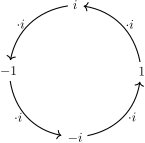
\[i^{4n}=1 \qquad i^{4n+1}=i \]
\[i^{4n+2}=-1 \qquad i^{4n+3}=-i\]
\begin{align*} (a+bi)^0 &= 1\\ (a+bi)^1 &= a+bi\\ (a+bi)^2 &= a^2-b^2 + 2abi\\ (a+bi)^3 &= (a^3 - 3ab^2) + (3a^2b -b^3)i\\ \end{align*}
7.1.4 Square Root of a Complex Number
Definition \(x+yi\) is a square root of \(a+bi\)
\[\Leftrightarrow (x+yi)^2 = a+bi\]
General Solution \((b \neq 0)\)
\(\seteqnumber{0}{7.}{0}\)\begin{align*} &(x+yi)^2 = a+bi \\ &\Leftrightarrow \begin{cases} x^2-y^2 &= a\\ 2xy &= b \end {cases}\\ &\Leftrightarrow x+yi = \pm \left ( \sqrt {\dfrac {r+a}{2}} + i\,\operatorname {sgn}(b)\sqrt {\dfrac {r-a}{2}} \right )\\ &\qquad \qquad \qquad \text {with } r=\sqrt {a^2+b^2} \end{align*}
Solutions of Real Numbers (\(b=0\))
\(\seteqnumber{0}{7.}{0}\)\begin{align*} a \geq 0 &: \qquad x+yi = \pm \sqrt {a}\\ a < 0 &: \qquad x+yi = \pm i\sqrt {-a} \end{align*}
7.1.5 Complex Quadratic Equations
Form of quadratic equation in \(\mathbb {C}\) is
\[az^2+bz+c=0 \text { with } a\in \mathbb {C}_0, b,c\in \mathbb {C}\]
-
• Every quadratic equation in \(\mathbb {C}\) has two solutions in \(\mathbb {C}\), counted with multiplicity.
-
• If \(a,b,c\in \mathbb {R}\), the solutions are either both real or a pair of non-real complex conjugates.
\[az^2+bz+c=0\]
-
• Calculate \(D=b^2-4ac\)
-
• Calculate \(\pm \sqrt {D}\)
-
• Calculate \(z_{1,2}=\dfrac {-b\pm \sqrt {D}}{2a}\)
7.1.6 Binomial Equations
Form of a binomial equation in the unknown \(z\) is
\[z^n = a \text { with } a \in \mathbb {C}_0, n \in \mathbb {N}_0\]
-
• A binomial equation has \(n\) different complex solutions.
-
• A binomial equation with \(a \in \mathbb {R}\) has at most 2 real solutions.
7.2 Polar Form
7.2.1 Polar Form
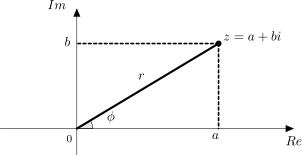
\[z = \underbrace {a+bi}_{\text {Cartesian}} = \underbrace {r(\cos \phi + i\sin \phi )}_{\text {Polar}}\]
-
• modulus \(r=|z|\) is the distance from the origin to the complex number
-
• For \(z\neq 0\), the principal argument \(\phi =\arg z\in [0,\adeg {360})\) is the angle between the positive real axis and the half-line from the origin through \(z\)
-
• \(\left \{\begin {alignedat}{2} r &= \sqrt {a^2+b^2} \\ \tan \phi &= \dfrac {b}{a} &\qquad (a\neq 0) \\ \phi &= \adeg {90}\,\vee \,\adeg {270} &\qquad (a=0) \end {alignedat}\right . \)
-
• Choose \(\phi \) in the quadrant determined by \(z=a+bi\).
-
• \(\begin {cases}a & = r \cdot \cos \phi \\ b & = r \cdot \sin \phi \end {cases}\)
-
• \(z_1=z_2 \Leftrightarrow r_1=r_2 \wedge \phi _1=\phi _2\)
-
• \(r\in \mathbb {R}^+\)
-
• \(z=0 \Rightarrow r=0 \) and \(\phi \) is undetermined
-
• \(|z| = |\overline {z}| \wedge \arg z \equiv -\arg \bar {z} \pmod {\adeg {360}}\)
-
• \(|z| = |-z| \wedge \arg (-z) \equiv \arg z + \adeg {180} \pmod {\adeg {360}}\)
\[ \begin {array}{c|c|c} z & r=|z| & \phi =\arg z\\ \hline 1 & 1 & \adeg {0}\\ i & 1 & \adeg {90}\\ -1 & 1 & \adeg {180}\\ -i & 1 & \adeg {270}\\ \end {array} \]
7.2.2 Operations in Polar Form
\[z_1 \cdot z_2 = r_1 r_2 \left (\cos (\phi _1 + \phi _2) + i \sin (\phi _1 + \phi _2)\right )\]
\[\dfrac {z_1}{z_2} = \dfrac {r_1}{r_2} \left (\cos (\phi _1 - \phi _2) + i \sin (\phi _1 - \phi _2)\right )\]
\[z^n = r^n \left (\cos (n\phi ) + i\sin (n\phi )\right )\]
7.2.3 Euler’s Formula
\[e^{i\phi } = \cos \phi + i\sin \phi \]
7.2.4 de Moivre’s Formula
\[\left ( \cos \phi + i\sin \phi \right )^n = \cos ( n\phi ) + i\sin ( n\phi )\]
7.3 Polynomials with Complex Coefficients
7.3.1 Definitions
Polynomial in one variable \(z\)
\(\seteqnumber{0}{7.}{0}\)\begin{align*} A(z) & = \sum ^n_{i=0}a_iz^i \\ & = a_nz^n + a_{n-1}z^{n-1}+ \cdots + a_1z + a_0 \end{align*}
-
• Coefficients: \(a_n, a_{n-1}, ..., a_1, a_0 \in \mathbb {C}\)
-
• Degree: \(\text {deg}(A) = n \in \mathbb {N}\)
-
• Notation: \(A(z), B(z), ...\)
-
• Set: \(\mathbb {C}[z]\)
-
• Numeric value \(A(z)\) for \(\omega = a+bi\) : \(A(\omega )\)
-
• Root \(\omega \) of \(A(z)\) \(\Leftrightarrow A(\omega ) = 0\)
7.3.2 Divisibility
Definition
\(A(z)\) is divisible by \(D(z)\)
\(\seteqnumber{0}{7.}{0}\)\begin{align*} & \Leftrightarrow D(z) | A(z) \\ & \Leftrightarrow \exists Q(z) \in \mathbb {C}[z] : A(z) = D(z) \cdot Q(z) \\ & \Leftrightarrow R(z) = 0 \end{align*}
-
• \(A(z)\) : dividend
-
• \(D(z)\) : divisor
-
• \(Q(z)\) : quotient
-
• \(R(z)\) : remainder
Criterion for divisibility
\(A(z)\) is divisible by \(z-\omega \)
\(\seteqnumber{0}{7.}{0}\)\begin{align*} & \Leftrightarrow z-\omega | A(z)\\ & \Leftrightarrow A(\omega ) = 0 \end{align*}
Product Divisibility
If \(\omega _1,\omega _2 \in \mathbb {C}\) and \(\omega _1 \neq \omega _2\) then
\[\left ( (z-\omega _1) \cdot (z-\omega 2) \right ) | A(z)\]
\[\qquad \qquad \Leftrightarrow (z-\omega _1) | A(z) \wedge (z-\omega _2) | A(z)\]
D’Alembert’s Theorem
(at least one root)
\[A(z) \in \mathbb {C}[z] \wedge \text {deg}\left (A(z)\right ) \geq 1\]
\[ \qquad \qquad \Longrightarrow \exists \omega \in \mathbb {C} : A(\omega ) = 0\]
Number of zeros
A polynomial of degree \(n\) has exactly \(n\) (possibly coinciding) roots in \(\mathbb {C}\)
Factorization
\(\seteqnumber{0}{7.}{0}\)\begin{align*} A(z) & = a_nz^n + a_{n-1}z^{n-1}+ \cdots + a_1z + a_0 \\ & = a_n(z-\omega _1)(z-\omega _2) \cdots (z-\omega _n) \end{align*}
-
• \(\omega _i\) : roots of \(A(z)\)