 Formularium
Chapter 4 Geometry
4.1 Plane Geometry
4.1.1 Points
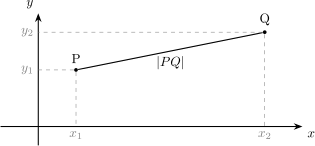
\[P(x_1,y_1) \wedge Q(x_2,y_2)\]
\[\Rightarrow d(P,Q) = |PQ| = \sqrt {(x_2-x_1)^2+(y_2-y_1)^2}\]
4.1.2 Lines
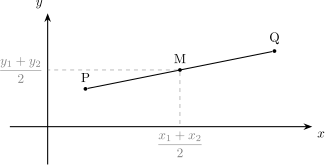
\[P(x_1,y_1) \wedge Q(x_2,y_2) \wedge M=\text {midpoint}_{[PQ]}\]
\[\Rightarrow co(M)=\left (\dfrac {x_1+x_2}{2},\dfrac {y_1+y_2}{2}\right )\]
-
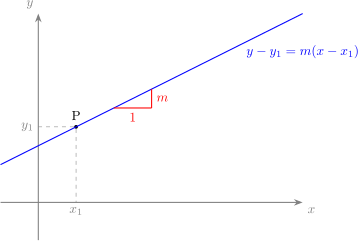
• Equation of a line passing through point \(P(x_1,y_1)\) with slope \(m\):
\[y - y_1 = m(x - x_1)\]
or
\[\begin {vmatrix}x & y & 1 \\ x_1 & y_1 & 1 \\ 1 & m & 0\end {vmatrix} = 0\]
-
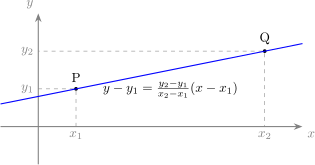
• Equation of a line passing through points \(P(x_1,y_1)\) and \(Q(x_2,y_2)\):
\[y - y_1 = \dfrac {y_2-y_1}{x_2-x_1}(x - x_1)\]
or
\[\begin {vmatrix}x & y & 1 \\ x_1 & y_1 & 1 \\ x_2 & y_2 & 1\end {vmatrix} = 0\]
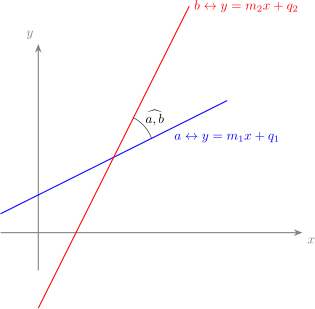
Relative position of two lines
If
\[a \leftrightarrow y = m_1 x + q_1 \wedge b \leftrightarrow y = m_2 x + q_2\]
-
• then the angle between \(a\) and \(b\) is given by \(\cos (\widehat {a,b}) = \dfrac {|1+m_1m_2|}{\sqrt {1+m_1^2}\sqrt {1+m_2^2}}\)
-
• \(a \parallel b\) if \(m_1=m_2\)
-
• \(a \perp b\) if \(m_1m_2=-1\)
Distance from a point to a line
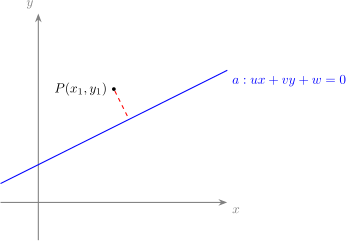
\[P(x_1,y_1) \wedge a \leftrightarrow ux+vy+w=0\]
\[\Rightarrow d(P,a) = \dfrac {|ux_1+vy_1+w|}{\sqrt {u^2+v^2}}\]
4.1.3 Triangles
\[P(x_1,y_1) \wedge Q(x_2,y_2) \wedge R(x_3,y_3)\]
\[\Rightarrow co(Z)=\left (\dfrac {x_1+x_2+x_3}{3},\dfrac {y_1+y_2+y_3}{3}\right )\]
with \(Z=\text {centroid}_{\Delta PQR}\)
4.1.4 Circles
A circle with center \(M\) and radius \(r\):
\[\mathcal {C}(M,r) = \{P \in \pi \;|\; d(P,M) = r\}\]
\[P(x,y) \in \mathcal {C}(M(a,b),r)\]
\[\Leftrightarrow (x-a)^2 + (y-b)^2 = r^2\]
4.2 Plane Figures
4.2.1 Concepts
4.2.2 Figures
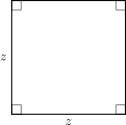
Square
-
• Figure with four equal sides and four right angles (\(\adeg {90}\)).
-
• \(z\) = side
-
• Area:
\[A = z^2\]
-
• Perimeter:
\[P = 4z\]
Rectangle
-
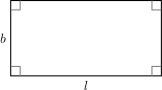
• Figure with two pairs of equal sides and four right angles (\(\adeg {90}\)).
-
• \(l\) = length
-
• \(w\) = width
-
• Area:
\[A = l \cdot w\]
-
• Perimeter:
\[P = 2l + 2w\]
Triangle
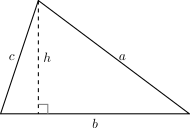
-
• Figure with three sides and three angles.
-
• \(b\) = base
-
• \(h\) = height
-
• Area:
\[A = \frac {1}{2} b \cdot h\]
-
• Perimeter:
\[P = a + b + c\]
(where \(a\), \(b\), and \(c\) are the lengths of the sides)
Circle
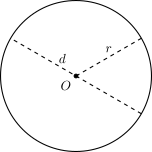
-
• Figure where all points on the boundary are equidistant from the center.
-
• \(r\) = radius
-
• \(d\) = diameter
-
• \(O\) = center
-
• Area:
\[A = \pi r^2\]
-
• Perimeter:
\[P = 2\pi r\]
or
\[P = \pi d\]
Parallelogram
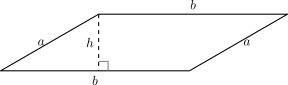
-
• Figure with two pairs of parallel sides.
-
• \(b\) = base
-
• \(h\) = height
-
• Area:
\[A = b \cdot h\]
-
• Perimeter:
\[P = 2a + 2b\]
(where \(a\) and \(b\) are the lengths of the sides)
Rhombus
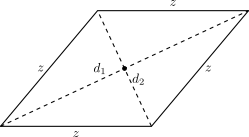
-
• Figure with four equal sides and opposite angles that are equal.
-
• \(d_1\) = long diagonal
-
• \(d_2\) = short diagonal
-
• Area:
\[A = \frac {1}{2} d_1 \cdot d_2\]
-
• Perimeter:
\[P = 4z\]
(where \(z\) is the side length)
Trapezoid
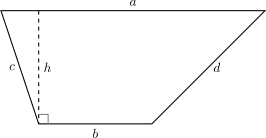
-
• Figure with one pair of parallel sides.
-
• \(a\) and \(b\) = lengths of the parallel sides
-
• \(h\) = height (distance between the parallel sides)
-
• Area:
\[A = \frac {1}{2} (a + b) \cdot h\]
-
• Perimeter:
\[P = a + b + c + d\]
(where \(c\) and \(d\) are the lengths of the non-parallel sides)
Ellipse
-
• Figure where the sum of the distances from any point on the boundary to two fixed points (foci) is constant.
-
• \(a\) = semi-major axis (long radius)
-
• \(b\) = semi-minor axis (short radius)
-
• Area:
\[A = \pi \cdot a \cdot b\]
-
• Perimeter:
\[P \approx \pi [3(a + b) - \sqrt {(3a + b)(a + 3b)}]\]
(approximation)
Kite
-
• Figure with two pairs of adjacent sides that are equal.
-
• \(d_1\) = long diagonal
-
• \(d_2\) = short diagonal
-
• Area:
\[A = \frac {1}{2} d_1 \cdot d_2\]
-
• Perimeter:
\[P = 2a + 2b\]
(where \(a\) and \(b\) are the lengths of the adjacent sides)
Regular Polygon
-
• Figure with equal sides and angles.
-
• \(n\) = number of sides
-
• \(z\) = side length
-
• \(r\) = apothem (distance from the center to the midpoint of a side)
-
• Area:
\[A = \frac {1}{2} n \cdot z \cdot r\]
-
• Perimeter:
\[P = n \cdot z\]
4.3 Synthetic Solid Geometry
4.3.1 Axioms
\[ \begin {array}{c|c|c} \bf symb & \bf name & \bf elements \\ \hline \Sigma & \text {space: set of points} & A,B,C,... \\ \mathcal {R} & \text {set of lines in } \Sigma & a, b, c, ... \\ \mathcal {P} & \text {set of planes in } \Sigma & \alpha , \beta , \gamma , ... \end {array} \]
-
• Space is an infinite set of points.
-
• A line is an infinite, non-empty subset of space.
-
• A plane is an infinite, non-empty subset of space.
-
• In every plane of space, the axioms and theorems of plane geometry hold.
-
• Through three non-collinear points \(A\), \(B\) and \(C\) there passes exactly one plane.
-
• If two distinct points of a line belong to a plane, then this line lies in that plane.
-
• Through two distinct points there passes at least one plane.
-
• Two distinct points determine exactly one line.
-
• Through a line there pass infinitely many planes.
4.3.2 Relative position
Two planes \(\alpha \) and \(\beta \)
-
• Coincident: \(\alpha \cap \beta = \alpha = \beta \)
-
• Strictly parallel: \(\alpha \cap \beta = \emptyset \)
-
• Intersecting: \(\alpha \cap \beta = \mathbf {line\ of\ intersection}\; s\)
Remark: parallel = coincident or strictly parallel
Line \(a\) and plane \(\alpha \)
-
• Contained in: \(a \parallel \alpha \wedge a \cap \alpha = a \Leftrightarrow a \subset \alpha \)
-
• Strictly parallel: \(a \parallel \alpha \wedge a \cap \alpha = \emptyset \)
-
• Intersecting: \(a \cap \alpha = \mathbf {point\ of\ intersection}\; \{S\}\)
Remark: parallel = contained in or strictly parallel
-
• Coincident: \(a \cap b = a = b\)
-
• Intersecting: \(a \cap b = \mathbf {point\ of\ intersection}\; \{S\}\)
-
• Strictly parallel: \(a \cap b = \emptyset \wedge a \parallel b\)
-
• Skew: \(a \cap b = \emptyset \wedge a \nparallel b\)
Remark: parallel = coincident or strictly parallel
4.4 Analytic Solid Geometry
4.4.1 Equations of a line
Line through a point with a direction vector
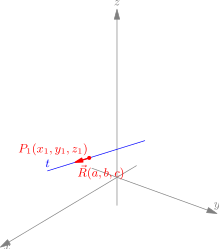
\begin{align*} \text {line } t &\leftrightarrow \text {through } P_1(x_1,y_1,z_1) \text { with direction vector } \vec {R}(a,b,c)\\ &\leftrightarrow \vec {P} = \vec {P_1} + k \cdot \vec {R}\\ &\leftrightarrow \begin{cases} x = x_1 + k \cdot a\\ y = y_1 + k \cdot b\\ z = z_1 + k \cdot c\end {cases} \qquad (k\in \mathbb {R})\\ &\leftrightarrow \begin{pmatrix}x\\y\\z\end {pmatrix} = \begin{pmatrix}x_1\\y_1\\z_1\end {pmatrix} + k \cdot \begin{pmatrix}a\\b\\c\end {pmatrix} \qquad (k\in \mathbb {R})\\ &\leftrightarrow \dfrac {x-x_1}{a}=\dfrac {y-y_1}{b}=\dfrac {z-z_1}{c} \qquad (a,b,c \in \mathbb {R}_0) \end{align*}
Line through two points
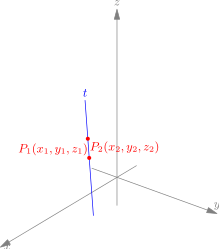
\begin{align*} \text {line } t &\leftrightarrow \text {through } P_1(x_1,y_1,z_1) \text { and } P_2(x_2, y_2, z_2)\\ &\leftrightarrow \vec {P} = \vec {P_1} + k \cdot (\vec {P_2} - \vec {P_1}) \qquad (k\in \mathbb {R})\\ &\leftrightarrow \begin{cases} x = x_1 + k \cdot (x_2 - x_1)\\ y = y_1 + k \cdot (y_2 - y_1)\\ z = z_1 + k \cdot (z_2 - z_1)\end {cases} \qquad (k\in \mathbb {R})\\ &\leftrightarrow \begin{pmatrix}x\\y\\z\end {pmatrix} = \begin{pmatrix}x_1\\y_1\\z_1\end {pmatrix} + k \cdot \begin{pmatrix}x_2 - x_1\\y_2 - y_1\\z_2 - z_1\end {pmatrix} \qquad (k\in \mathbb {R})\\ &\leftrightarrow \dfrac {x-x_1}{x_2-x_1}=\dfrac {y-y_1}{y_2-y_1}=\dfrac {z-z_1}{z_2-z_1} \qquad (x_2 \neq x_1, y_2 \neq y_1, z_2 \neq z_1) \end{align*}
Special lines
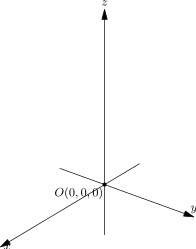
\begin{align*} x\text {-axis} &\leftrightarrow y = z = 0\\ y\text {-axis} &\leftrightarrow x = z = 0\\ z\text {-axis} &\leftrightarrow x = y = 0 \end{align*}
4.4.2 Equations of a plane
Plane through a point with two direction vectors
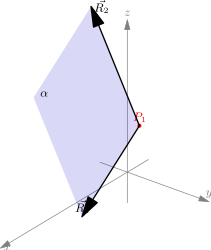
\begin{align*} \text {plane } \alpha &\leftrightarrow \text {through } P_1(x_1, y_1, z_1) \text { with direction vectors } \vec {R_1}(a_1, b_1, c_1) \text { and } \vec {R_2}(a_2, b_2, c_2) \\ &\leftrightarrow \vec {P} = \vec {P_1} + k \cdot \vec {R_1} + l \cdot \vec {R_2} \qquad (k,l\in \mathbb {R}) \\ &\leftrightarrow \begin{cases} x = x_1 + k \cdot a_1 + l \cdot a_2\\ y = y_1 + k \cdot b_1 + l \cdot b_2\\ z = z_1 + k \cdot c_1 + l \cdot c_2\end {cases} \qquad (k,l\in \mathbb {R}) \\ &\leftrightarrow \begin{pmatrix}x\\y\\z\end {pmatrix} = \begin{pmatrix}x_1\\y_1\\z_1\end {pmatrix} + k \cdot \begin{pmatrix}a_1\\b_1\\c_1\end {pmatrix} + l \cdot \begin{pmatrix}a_2\\b_2\\c_2\end {pmatrix} \qquad (k,l\in \mathbb {R}) \\ &\leftrightarrow \begin{vmatrix}x-x_1 & a_1 & a_2 \\y-y_1 & b_1 & b_2 \\z-z_1 & c_1 & c_2\end {vmatrix} = 0\\ &\leftrightarrow \begin{vmatrix}x & y & z & 1 \\x_1 & y_1 & z_1 & 1 \\a_1 & b_1 & c_1 & 0 \\a_2 & b_2 & c_2 & 0\end {vmatrix}= 0 \end{align*}
Plane through three points
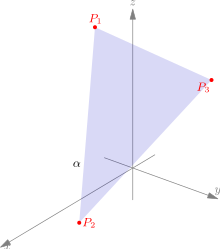
\begin{align*} \text {plane } \alpha &\leftrightarrow \text {through } P_1(x_1, y_1, z_1)\text {, } P_2(x_2, y_2, z_2) \text { and } P_3(x_3, y_3, z_3)\\ &\leftrightarrow \vec {P} = \vec {P_1} + k \cdot (\vec {P_2} - \vec {P_1}) + l \cdot (\vec {P_3} - \vec {P_1}) \qquad (k,l\in \mathbb {R}) \\ &\leftrightarrow \begin{cases} x = x_1 + k \cdot (x_2- x_1) + l \cdot (x_3 - x_1)\\ y = y_1 + k \cdot (y_2-y_1) + l \cdot (y_3-y_1)\\ z = z_1 + k \cdot (z_2-z_1) + l \cdot (z_3-z_1)\end {cases} \qquad (k,l\in \mathbb {R}) \\ &\leftrightarrow \begin{pmatrix}x\\y\\z\end {pmatrix} = \begin{pmatrix}x_1\\y_1\\z_1\end {pmatrix} + k \cdot \begin{pmatrix}x_2- x_1\\y_2-y_1\\z_2-z_1\end {pmatrix} + l \cdot \begin{pmatrix}x_3-x_1\\y_3-y_1\\z_3-z_1\end {pmatrix} \qquad (k,l\in \mathbb {R}) \\ &\leftrightarrow \begin{vmatrix}x & y & z & 1 \\x_1 & y_1 & z_1 & 1 \\x_2 & y_2 & z_2 & 1 \\x_3 & y_3 & z_3 & 1\end {vmatrix}= 0 \end{align*}
General form of a plane
\[\text {plane } \alpha \leftrightarrow ux + vy + wz + t = 0\]
-
• \(u\), \(v\), \(w\): direction coefficients of the plane
-
• \(\vec {n} = (u, v, w)\): normal vector, \(\vec {n} \perp \alpha \)
-
• \(t\): constant term, position relative to \(\vec {O}\)
-
• \(t = 0 \Leftrightarrow \vec {O} \in \alpha \Leftrightarrow \alpha = \alpha _O\)
Plane in intercept form
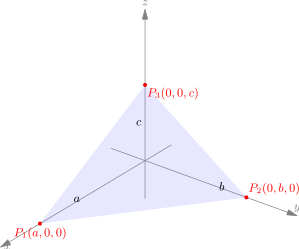
\[\dfrac {x}{a} + \dfrac {y}{b} + \dfrac {z}{c} = 1\]
-
• \(a\): length of the intercept on the \(x\)-axis
-
• \(b\): length of the intercept on the \(y\)-axis
-
• \(c\): length of the intercept on the \(z\)-axis
-
• \(a\), \(b\) and \(c\): the intercepts
Special planes
-
• \(xy\)-plane: \(z=0\)
-
• \(xz\)-plane: \(y=0\)
-
• \(yz\)-plane: \(x=0\)
4.4.3 Relative position of lines
The lines
\(\seteqnumber{0}{4.}{0}\)\begin{align*} e &\leftrightarrow \vec {P_e} = \vec {P_{e_1}} + k \cdot \vec {R_e}\\ f &\leftrightarrow \vec {P_f} = \vec {P_{f_1}} + l \cdot \vec {R_f} \end{align*} with
\(\seteqnumber{0}{4.}{0}\)\begin{align*} P_{e_1}(x_1,y_1,z_1), R_e(a_1,b_1,c_1)\\ P_{f_1}(x_2,y_2,z_2), R_f(a_2,b_2,c_2) \end{align*}
Parallel
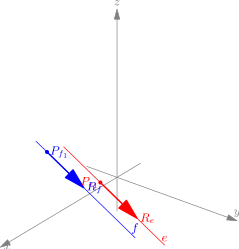
\begin{align*} e \parallel f &\Leftrightarrow \text {direction ratios are proportional}\\ &\Leftrightarrow \exists k \in \mathbb {R} : (a_1,b_1,c_1) = k \cdot (a_2, b_2, c_2) \\ &\Leftrightarrow \dfrac {a_1}{a_2} = \dfrac {b_1}{b_2} = \dfrac {c_1}{c_2} \end{align*}
Intersecting
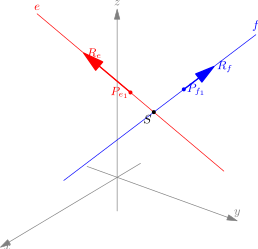
\begin{align*} e \text { intersects } f &\Leftrightarrow \exists ! \text { solution }(k,l) : P_e = P_f\\ &\Leftrightarrow \begin{cases} (a_1,b_1,c_1) \not \sim (a_2,b_2,c_2) \\ \begin{vmatrix}a_1 & a_2 & x_2 - x_1\\b_1 & b_2 & y_2 - y_1\\c_1 & c_2 & z_2 - z_1\\\end {vmatrix} = 0 \end {cases} \end{align*}
Skew
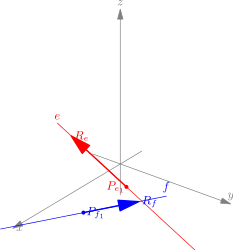
\begin{align*} e \text { is skew to } f &\Leftrightarrow \nexists \text { solution }(k,l) : P_e = P_f\\ &\Leftrightarrow \begin{cases} (a_1,b_1,c_1) \not \sim (a_2,b_2,c_2) \\ \begin{vmatrix}a_1 & a_2 & x_2 - x_1\\b_1 & b_2 & y_2 - y_1\\c_1 & c_2 & z_2 - z_1\\\end {vmatrix} \neq 0 \end {cases} \end{align*}
4.4.4 Relative position of a line and a plane
\(\seteqnumber{0}{4.}{0}\)\begin{align*} \text {line } e &\leftrightarrow \begin{cases} x = x_1 + k \cdot a\\ y = y_1 + k \cdot b\\ z = z_1 + k \cdot c\end {cases} \qquad (k\in \mathbb {R})\\ \text {plane } \alpha &\leftrightarrow ux + vy + wz + t = 0 \end{align*}
Intersecting
\[e \text { intersects } \alpha \Leftrightarrow ua + vb + wc \neq 0\]
Parallel
\[e \parallel \alpha \Leftrightarrow ua + vb + wc = 0\]
Line contained in the plane
\[e \subset \alpha \Leftrightarrow ua + vb + wc = 0 \wedge ux_1+vy_1+wz_1+t=0\]
4.4.5 Relative position of planes
\(\seteqnumber{0}{4.}{0}\)\begin{align*} \text {plane } \alpha &\leftrightarrow u_1x + v_1y + w_1z + t_1 = 0\\ \text {plane } \beta &\leftrightarrow u_2x + v_2y + w_2z + t_2 = 0 \end{align*}
Intersecting
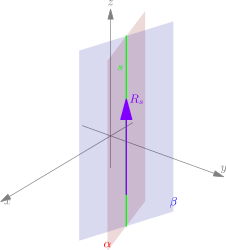
\[\alpha \text { intersects } \beta \Leftrightarrow (u_1,v_1,w_1) \not \sim (u_2,v_2,w_2)\]
-
• line of intersection: \(s = \alpha \cap \beta \):
-
• direction ratios of the line of intersection: \(R_s(a,b,c)\):
\(\seteqnumber{0}{4.}{0}\)\begin{align*} a &= \lambda \cdot \begin{vmatrix}v_1 & w_1\\v_2 & w_2\end {vmatrix}\\ b &= - \lambda \cdot \begin{vmatrix}u_1 & w_1\\u_2 & w_2\end {vmatrix}\qquad \lambda \text { arbitrary }\in \mathbb {R}_0\\ c &= \lambda \cdot \begin{vmatrix}u_1 & v_1\\u_2 & v_2\end {vmatrix} \end{align*}
Parallel
\[\alpha \parallel \beta \Leftrightarrow (u_1,v_1,w_1) \sim (u_2,v_2,w_2)\]
Coincident
\[\alpha = \beta \Leftrightarrow (u_1,v_1,w_1,t_1) \sim (u_2,v_2,w_2,t_2)\]
4.5 Solids
4.5.1 Concepts
Volume: Amount of space occupied by the figure.
Surface area: Sum of the surfaces of all side faces.
Net: 2D representation by unfolding the side faces and laying them flat.
4.5.2 Figures
Polyhedron
3D figure with polygonal surfaces
Prism
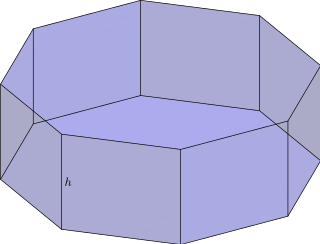
-
• Polyhedron with parallel, congruent bases connected by rectangular side faces.
-
• \(B\) = base area
-
• \(h\) = height
-
• \(P\) = base perimeter
-
• Volume:
\[V = B \cdot h\]
-
• Surface area:
\[A = 2B + P \cdot h\]
Pyramid
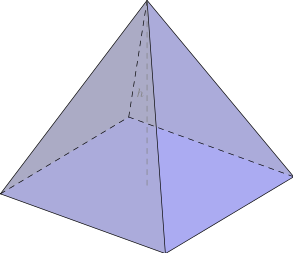
-
• Polyhedron with a polygonal base and triangular faces that meet at a vertex.
-
• \(B\) = base area
-
• \(h\) = height
-
• Volume:
\[V = \frac {1}{3} B \cdot h\]
Cube
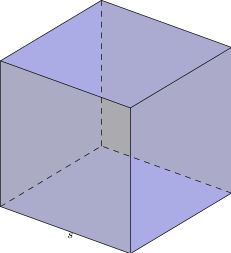
-
• Prism with six square faces, equal sides, and \(\adeg {90}\) angles.
-
• \(s\) = side
-
• Volume:
\[V = s^3\]
-
• Surface area:
\[A = 6s^2\]
Rectangular Prism
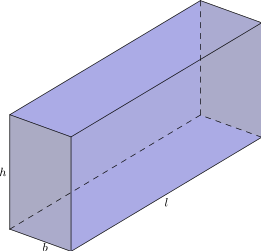
-
• Prism with six rectangular faces.
-
• \(l\) = length
-
• \(w\) = width
-
• \(h\) = height
-
• Volume:
\[V = l \cdot w \cdot h\]
-
• Surface area:
\[A = 2lw + 2lh + 2wh\]
Cylinder
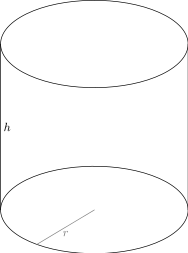
-
• 3D figure with congruent circular bases connected by a curved surface.
-
• \(r\) = radius
-
• \(h\) = height
-
• Volume:
\[V = \pi r^2 h\]
-
• Surface area:
\[A = 2\pi r(r + h)\]
Cone
-
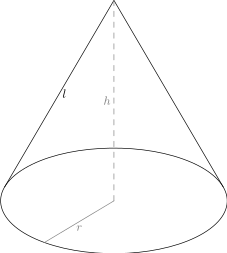
• 3D figure with a circular base and a curved surface that narrows to a point.
-
• \(r\) = radius
-
• \(h\) = height
-
• \(l\) = slant height
-
• Volume:
\[V = \frac {1}{3} \pi r^2 h\]
-
• Surface area:
\[A = \pi r(r + l)\]
Sphere
-
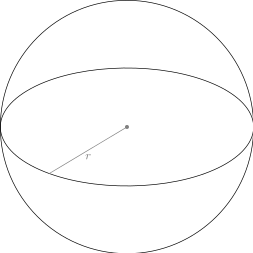
• 3D figure with all points at equal distance from the center.
-
• \(r\) = radius
-
• Volume:
\[V = \frac {4}{3} \pi r^3\]
-
• Surface area:
\[A = 4\pi r^2\]
4.6 Vectors
4.6.1 Definitions of vectors
Bound vector \(\vec {v}=\vec {AB}\) a line segment with
-
• a starting point \(A\)
-
• an end point \(B\)
-
• a length \(|AB|\)
-
• a direction, line \(AB\)
-
• a sense, \(A \to B\)
Free vector a collection of line segments with
-
• the same length
-
• the same direction
-
• the same sense
Representative one arbitrary line segment from the free vector
Position vector \(\vec {A} = \vec {OA}\) with \(O\) being the origin
Zero vector \(\vec {o}\) : length \(0\)
Notation: \(\vec {u}, \vec {v}, ...\)
Coordinate \(co(\vec {A}) = co(A) = (x,y,z)\)
Norm of \(\vec {v} = \vec {AB}\) is the distance between \(A\) and \(B\)
\[\| \vec {v} \| = |AB|\]
4.6.2 Adding vectors
Chasles-Möbius formula
\[\vec {AB} + \vec {BC} = \vec {AC}\]
With coordinates
\(\left .\begin {aligned}co(\vec {u}) &= (x_1, y_1, z_1)\\ co(\vec {v}) &= (x_2, y_2, z_2)\end {aligned}\right \rbrace \Rightarrow \)
\[co(\vec {u} + \vec {v}) = (x_1+x_2, y_1+y_2,z_1+z_2)\]
Properties
-
• I: \(\forall \vec {u}, \vec {v} \in \mathcal {V} : \vec {u} + \vec {v} \in \mathcal {V}\)
-
• A: \(\forall \vec {u}, \vec {v}, \vec {w} \in \mathcal {V} : (\vec {u} + \vec {v}) + \vec {w} = \vec {u} + (\vec {v} + \vec {w})\)
-
• N: \(\exists \vec {o} \in \mathcal {V}, \forall \vec {u} \in \mathcal {V} : \vec {u} + \vec {o} = \vec {u} = \vec {o} + \vec {u}\)
-
• S: \(\forall \vec {u} \in \mathcal {V}, \exists ! \vec {-u} \in \mathcal {V} : \vec {u} + (\vec {-u}) = \vec {o} = (\vec {-u}) + \vec {u}\)
-
• C: \(\forall \vec {u}, \vec {v} \in \mathcal {V} : \vec {u} + \vec {v} = \vec {v} + \vec {u}\)
\[\Rightarrow \mathcal {V}, + \text { is a commutative group}\]
4.6.3 Scalar multiplication of vectors
Definition
\[r \cdot \vec {v} (r\in \mathbb {R}_0, \vec {v} \in \mathcal {V}_o)\]
is a vector with
-
• length equal to \(|r| \cdot \| \vec {v} \|\)
-
• direction as \(\vec {v}\)
-
• sense \(\begin {cases} \text {as } \vec {v} &(r>0)\\ \text {opposite } \vec {v} &(r<0)\end {cases}\)
\[0 \cdot \vec {v} = \vec {o}\]
\[r \cdot \vec {o} = \vec {o}\]
With coordinates
\(co(\vec {v}) = (x,y,z) \Rightarrow \)
\[co(r\vec {v}) = (rx,ry,rz)\]
Properties
-
• \(\forall r \in \mathbb {R}, \forall \vec {v} \in \mathcal {V} : r \cdot \vec {v} \in \mathcal {V}\)
-
• \(\forall r,s \in \mathbb {R}, \forall \vec {v} \in \mathcal {V} : r \cdot (s \cdot \vec {v}) = (r \cdot s) \cdot \vec {v}\)
-
• \(\forall r \in \mathbb {R}, \forall \vec {u}, \vec {v} \in \mathcal {V} : r \cdot (\vec {u} + \vec {v}) = r \cdot \vec {u} + r \cdot \vec {v}\)
-
• \(\forall r,s \in \mathbb {R}, \forall \vec {v} \in \mathcal {V} : (r + s) \cdot \vec {v} = r \cdot \vec {v} + s \cdot \vec {v}\)
-
• \(\exists 1 \in \mathbb {R}, \forall \vec {v} \in \mathcal {V} : 1 \cdot \vec {v} = \vec {v}\)
4.6.4 Norm of a Vector
Definition
norm of \(\vec {v} = \vec {AB}\) is the distance between \(A\) and \(B\)
\[\| \vec {v} \| = d(A,B) = |AB|\]
With Coordinates
\(co(\vec {v}) = (x,y,z) \Rightarrow \)
\[\| \vec {v} \| = \sqrt {x^2 + y^2 + z^2}\]
Minkowski Inequality
\[\|\vec {u} + \vec {v}\| \leq \|\vec {u}\| + \|\vec {v}\|\]
4.6.5 Dot Product of Two Vectors
Definition
\(\vec {u}, \vec {v} \in \mathcal {V}_0\) and \(\phi \) is the angle between \(\vec {u}\) and \(\vec {v}\) \(\Rightarrow \)
\[\vec {u} \cdot \vec {v} = \|\vec {u}\| \cdot \|\vec {v}\| \cdot \cos {\phi }\]
With Coordinates
\(\left .\begin {aligned}co(\vec {u}) &= (x_1, y_1, z_1)\\ co(\vec {v}) &= (x_2, y_2, z_2)\end {aligned}\right \rbrace \Rightarrow \)
\[\vec {u} \cdot \vec {v} = x_1 \cdot x_2 + y_1 \cdot y_2 + z_1 \cdot z_2\]