 Formularium
Hoofdstuk 7 Complexe getallen
7.1 Complexe getallen
7.1.1 Definities complexe getallen
-
• \(i\) is de imaginaire eenheid met
\[i^2 = -1\]
-
• Gevolg:
\[i^n = i^{n+4} \qquad (n \in \mathbb {N})\]
-
• \(\mathbb {I}\): verzameling van imaginaire getallen
\[\mathbb {I} = \{bi \;|\; b \in \mathbb {R} \wedge i^2 = -1\}\]
-
• Een complex getal heeft de vorm
\[z = a+bi \qquad \text { met } a,b \in \mathbb {R}\]
-
• \(a = \mathcal {R}e(z)\) : reële deel
-
• \(b = \mathcal {I}m(z)\) : imaginaire deel
-
• Een complex getal is zuiver imaginair
\[\Leftrightarrow a = 0 \wedge b \neq 0\]
-
• \(\mathbb {C}\): verzameling van complexe getallen
\[\mathbb {C} = \{a+bi \;|\; a,b \in \mathbb {R} \wedge i^2 = -1\}\]
-
• \(z_1=a+bi\) en \(z_2=c+di\) zijn gelijk
\[\Leftrightarrow a=c \wedge b=d\]
-
• \(z\) en \(\bar {z}\) zijn elkaars complex toegevoegden
\[\Leftrightarrow z=a+bi \;\wedge \;\bar {z}=a-bi\]
7.1.2 Bewerkingen complexe getallen
\[(a+bi) + (c+di) = (a+c) + (b+d)i\]
\[(a+bi) - (c+di) = (a-c) + (b-d)i\]
-
• Som imaginaire:
\[ai+bi = (a+b)i \in \mathbb {I}\]
-
• Som toegevoegden:
\[(a+bi)+(a-bi)=2a \in \mathbb {R}\]
-
• \(\mathbb {C},+\) is een commutatieve groep
-
– Inwendig
-
– Associatief
-
– Neutraal element: \(0\)
-
– Symmetrisch element: \(-z\)
-
– Commutatief
-
\[(a+bi) \cdot (c+di) = (ac-bd) + (ad+bc)i\]
-
• Product imaginaire:
\[ai \cdot bi = -ab \in \mathbb {R}\]
-
• Product toegevoegden:
\[(a+bi) \cdot (a-bi) = a^2+b^2 \in \mathbb {R}\]
-
• \(\mathbb {C}_0,\cdot \) is een commutatieve groep
-
– Inwendig
-
– Associatief
-
– Neutraal element: \(1\)
-
– Symmetrisch element:
\[z^{-1}=\dfrac {a}{a^2+b^2} + \dfrac {-b}{a^2+b^2}i\]
-
– Commutatief
-
\[\dfrac {a+bi}{c+di} = \dfrac {ac+bd}{c^2+d^2} + \dfrac {bc-ad}{c^2+d^2}i\]
-
• Praktisch: Teller en noemer \(\Large \times \) toegevoegde
-
• Quotiënt imaginaire: \(\dfrac {ai}{bi} = \dfrac {a}{b} \in \mathbb {R}\)
-
• Quotiënt toegevoegden: \(\dfrac {z}{\bar {z}} \in \mathbb {C}\)
7.1.3 Machten van complexe getallen
\(\seteqnumber{0}{7.}{0}\)\begin{align*} (a+bi)^n &= \underbrace {(a+bi)\cdot (a+bi)\cdot \cdots \cdot (a+bi)}_{n \text { \scriptsize factoren}}\\ (a+bi)^1 &= a+bi\\ (a+bi)^0 &= 1\\ (a+bi)^{-n} &= \dfrac {1}{(a+bi)^{n}} \end{align*}
Machten van de imaginaire eenheid
\[i^{4n}=1 \qquad i^{4n+1}=i \]
\[i^{4n+2}=-1 \qquad i^{4n+3}=-i\]
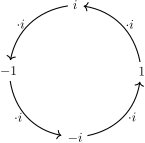
\begin{align*} (a+bi)^0 &= 1\\ (a+bi)^1 &= a+bi\\ (a+bi)^2 &= a^2-b^2 + 2abi\\ (a+bi)^3 &= (a^3 - 3ab^2) + (3a^2b -b^3)i\\ \end{align*}
7.1.4 Vierkantswortel van een complex getal
Definitie \(x+yi\) is een vierkantswortel uit \(a+bi\)
\[\Leftrightarrow (x+yi)^2 = a+bi\]
Algemene oplossing \((b \neq 0)\)
\(\seteqnumber{0}{7.}{0}\)\begin{align*} &(x+yi)^2 = a+bi \\ &\Leftrightarrow \begin{cases} x^2-y^2 &= a\\ 2xy &= b \end {cases}\\ &\Leftrightarrow x+yi = \pm \left ( \sqrt {\dfrac {r+a}{2}} + i\,\operatorname {sgn}(b)\sqrt {\dfrac {r-a}{2}} \right )\\ &\qquad \qquad \qquad \text {met } r=\sqrt {a^2+b^2} \end{align*}
Oplossingen voor reële getallen (\(b=0\))
\(\seteqnumber{0}{7.}{0}\)\begin{align*} a \geq 0 &: \qquad x+yi = \pm \sqrt {a}\\ a < 0 &: \qquad x+yi = \pm i\sqrt {-a} \end{align*}
7.1.5 Complexe vierkantsvergelijkingen
Vorm vierkantsvergelijking in \(\mathbb {C}\) is
\[az^2+bz+c=0 \text { met } a\in \mathbb {C}_0, b,c\in \mathbb {C}\]
-
• Elke vierkantsvergelijking in \(\mathbb {C}\) heeft twee oplossingen in \(\mathbb {C}\), geteld met multipliciteit.
-
• Als \(a,b,c\in \mathbb {R}\), zijn de oplossingen ofwel beide reëel, ofwel een paar niet-reële complex toegevoegde getallen.
\[az^2+bz+c=0\]
-
• Bereken \(D=b^2-4ac\)
-
• Bereken \(\pm \sqrt {D}\)
-
• Bereken \(z_{1,2}=\dfrac {-b\pm \sqrt {D}}{2a}\)
7.1.6 Binomiaalvergelijkingen
Vorm binomiaalvergelijking in de onbekende \(z\) is
\[z^n = a \text { met } a \in \mathbb {C}_0, n \in \mathbb {N}_0\]
-
• Een binomiaalvergelijking heeft \(n\) verschillende complexe oplossingen.
-
• Een binomiaalvergelijking met \(a \in \mathbb {R}\) heeft hoogstens 2 reële oplossingen.
7.2 Goniometrische gedaante
7.2.1 Goniometrische gedaante
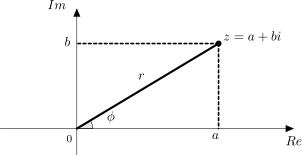
\[z = \underbrace {a+bi}_{\text {cartesisch}} = \underbrace {r(\cos \phi + i\sin \phi )}_{\text {goniometrisch}}\]
-
• modulus \(r=|z|\) is afstand oorsprong tot complex getal
-
• Voor \(z\neq 0\) is het hoofdargument \(\phi =\arg z\in [0,\adeg {360}[\) de hoek tussen de positieve reële as en de halfrechte vanuit de oorsprong door \(z\)
-
• \(\left \{\begin {alignedat}{2} r &= \sqrt {a^2+b^2} \\ \tan \phi &= \dfrac {b}{a} &\qquad (a\neq 0) \\ \phi &= \adeg {90}\,\vee \,\adeg {270} &\qquad (a=0) \end {alignedat}\right . \)
-
• Kies \(\phi \) in het kwadrant bepaald door \(z=a+bi\).
-
• \(\begin {cases}a & = r \cdot \cos \phi \\ b & = r \cdot \sin \phi \end {cases}\)
-
• \(z_1=z_2 \Leftrightarrow r_1=r_2 \wedge \phi _1=\phi _2\)
-
• \(r\in \mathbb {R}^+\)
-
• \(z=0 \Rightarrow r=0 \) en \(\phi \) is onbepaald
-
• \(|z| = |\overline {z}| \wedge \arg z \equiv -\arg \bar {z} \pmod {\adeg {360}}\)
-
• \(|z| = |-z| \wedge \arg (-z) \equiv \arg z + \adeg {180} \pmod {\adeg {360}}\)
\[ \begin {array}{c|c|c} z & r=|z| & \phi =\arg z\\ \hline 1 & 1 & \adeg {0}\\ i & 1 & \adeg {90}\\ -1 & 1 & \adeg {180}\\ -i & 1 & \adeg {270}\\ \end {array} \]
7.2.2 Bewerkingen in goniometrische vorm
\[z_1 \cdot z_2 = r_1 r_2 \left (\cos (\phi _1 + \phi _2) + i \sin (\phi _1 + \phi _2)\right )\]
\[\dfrac {z_1}{z_2} = \dfrac {r_1}{r_2} \left (\cos (\phi _1 - \phi _2) + i \sin (\phi _1 - \phi _2)\right )\]
\[z^n = r^n \left (\cos (n\phi ) + i\sin (n\phi )\right )\]
7.2.3 Formule van Euler
\[e^{i\phi } = \cos \phi + i\sin \phi \]
7.2.4 Formule van de Moivre
\[\left ( \cos \phi + i\sin \phi \right )^n = \cos ( n\phi ) + i\sin ( n\phi )\]
7.3 Veeltermen met complexe coëfficiënten
7.3.1 Definities
Veelterm in één veranderlijke \(z\)
\(\seteqnumber{0}{7.}{0}\)\begin{align*} A(z) & = \sum ^n_{i=0}a_iz^i \\ & = a_nz^n + a_{n-1}z^{n-1}+ \cdots + a_1z + a_0 \end{align*}
-
• Coëfficiënten : \(a_n, a_{n-1}, ..., a_1, a_0 \in \mathbb {C}\)
-
• Graad : \(\text {gr}(A) = n \in \mathbb {N}\)
-
• Notatie: \(A(z), B(z), ...\)
-
• Verzameling: \(\mathbb {C}[z]\)
-
• Getalwaarde \(A(z)\) voor \(\omega = a+bi\) : \(A(\omega )\)
-
• Wortel \(\omega \) van \(A(z)\) \(\Leftrightarrow A(\omega ) = 0\)
7.3.2 Deelbaarheid
Definitie
\(A(z)\) is deelbaar door \(D(z)\)
\(\seteqnumber{0}{7.}{0}\)\begin{align*} & \Leftrightarrow D(z) | A(z) \\ & \Leftrightarrow \exists Q(z) \in \mathbb {C}[z] : A(z) = D(z) \cdot Q(z) \\ & \Leftrightarrow R(z) = 0 \end{align*}
-
• \(A(z)\) : deeltal
-
• \(A(z)\) : deler
-
• \(D(z)\) : quotiënt
-
• \(R(z)\) : rest
Criterium deelbaarheid
\(A(z)\) is deelbaar door \(z-\omega \)
\(\seteqnumber{0}{7.}{0}\)\begin{align*} & \Leftrightarrow z-\omega | A(z)\\ & \Leftrightarrow A(\omega ) = 0 \end{align*}
Product deelbaar
Als \(\omega _1,\omega _2 \in \mathbb {C}\) en \(\omega _1 \neq \omega _2\) dan
\[\left ( (z-\omega _1) \cdot (z-\omega 2) \right ) | A(z)\]
\[\qquad \qquad \Leftrightarrow (z-\omega _1) | A(z) \wedge (z-\omega _2) | A(z)\]
Stelling van d’Alembert
(minstens één wortel)
\[A(z) \in \mathbb {C}[z] \wedge \text {gr}\left (A(z)\right ) \geq 1\]
\[ \qquad \qquad \Longrightarrow \exists \omega \in \mathbb {C} : A(\omega ) = 0\]
Aantal nulwaarden
Een veelterm van graad \(n\) heeft precies \(n\) (mogelijks samenvallende) wortel in \(\mathbb {C}\)
Ontbinding in factoren
\(\seteqnumber{0}{7.}{0}\)\begin{align*} A(z) & = a_nz^n + a_{n-1}z^{n-1}+ \cdots + a_1z + a_0 \\ & = a_n(z-\omega _1)(z-\omega _2) \cdots (z-\omega _n) \end{align*}
-
• \(\omega _i\) : wortels van \(A(z)\)